• Skip to primary navigation
  • Skip to main content
  • Skip to primary sidebar

Western Garden Centers

for what grows here

  • Home
  • How To
  • Gift Cards
  • Calculate Mulch
  • Locations
    • Store Hours
    • About
    • Garden Shop Employment Team
  • Weddings
    • Salt Lake City, UT
    • West Valley, UT
  • Blog
    • Gardening
    • Recipes

Tips & How To's

Gluten and Dairy Free Peach Cobbler

August 26, 2017 by Vanessa Roush

Having someone over for dessert but you have no idea what to feed them because they’re Gluten Free, Dairy Free, or Vegan? Here’s a recipe for gluten and dairy free peach cobbler that will be sure to impress those with or without food allergies.  And this recipe is just in time for the ripening of your Red Haven peaches from your tree.

Gluten and dairy free peach cobbler recipe

INGREDIENTS

2 cups sliced fresh, frozen, or canned peaches
1-2 tsp lemon juice
3 Tbsp coconut oil
1/2 tsp almond extract
dash of cinnamon (optional, but highly recommended)
3/4 cups sugar
2/3 cup almond flour or brown rice flour
1/3 cup tapioca flour
1 tsp baking powder
dash of salt
1/2 cup coconut milk
1 tsp xanthum gum (you can omit this if you don’t have it, it just makes the flours stick together since they don’t have gluten in them)
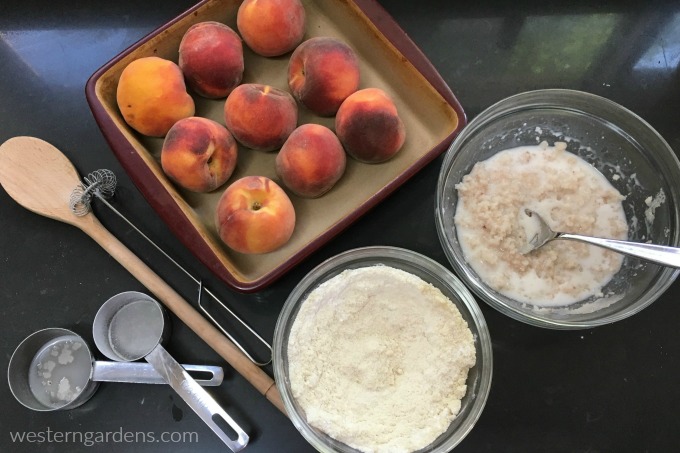
fresh peaches from your tree you bought at Western Gardens are the best for this peach cobbler

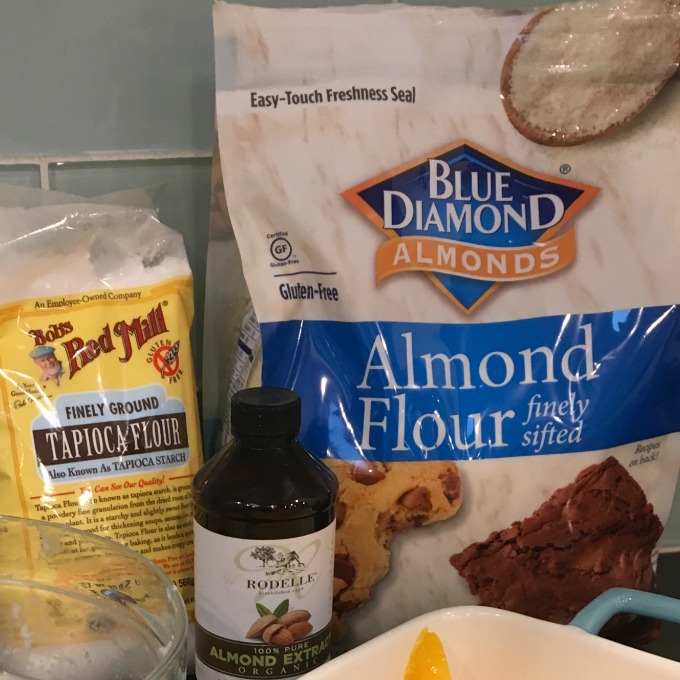
gluten free ingredients include almond flour, tapioca flour, and almond extract

DIRECTIONS

Peach preparation:

First, peel and slice your fresh peaches and place fruit in 2 1/2 quart dish and drip lemon juice over them.  If you use canned peaches, drain and dump in dish.
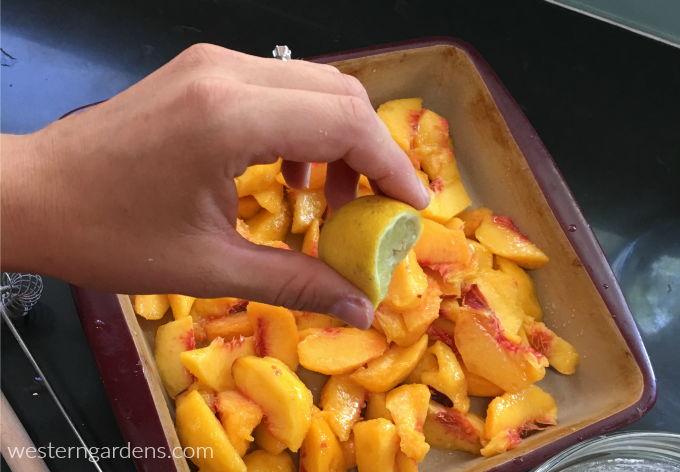
squeeze lemon juice on gluten free peach cobblerBatter:

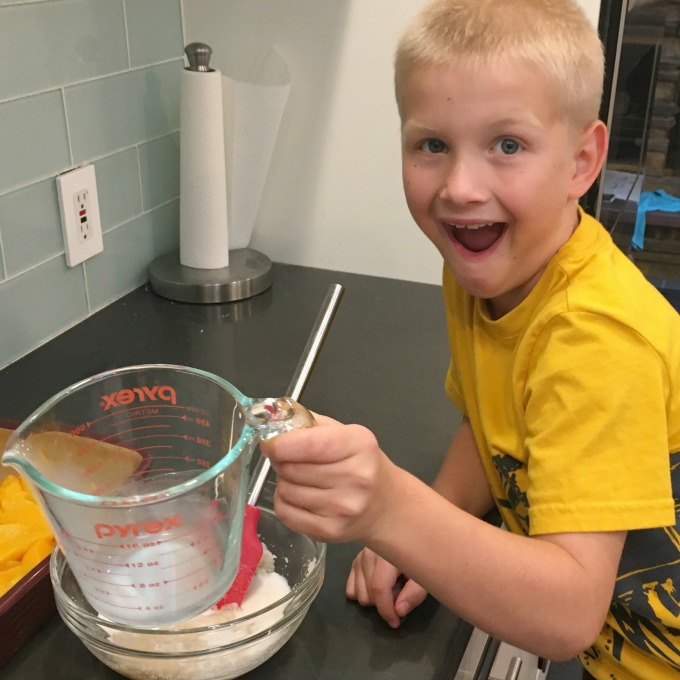
  1.  Cream together melted coconut oil and sugar, then add almond extract. kids in the kitchen making peach cobblerThis peach cobbler recipe is fun and easy for kids in the kitchen

  2.  Add in coconut milk, then rice/almond flour, tapioca flour, baking powder, xanthum gum and dash of salt.
  3. Mix well and spread over fruit. This will be thick and a tad lumpy.

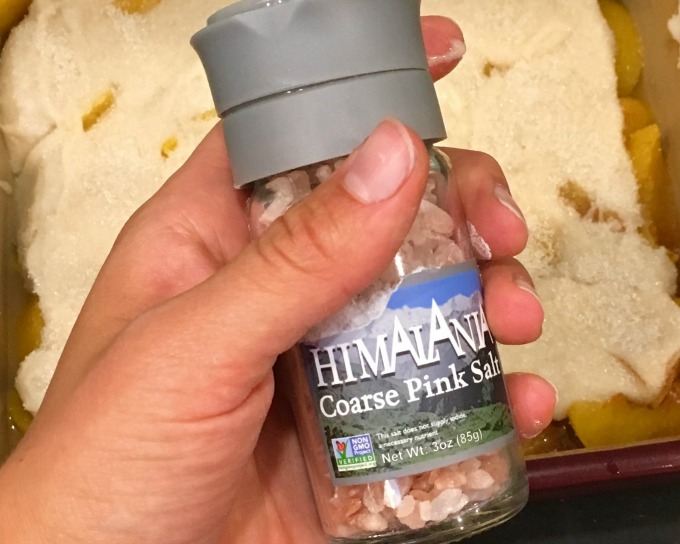
  4. After this, I like to lightly sprinkle the top with a little sugar and a little freshly ground salt.coarse pink salt for peach cobbler

Bake at 350 degrees F for about 25-30 minutes. I bake the cobbler until it starts to look caramelized on top, which gives a bit of a crunch to go with the chewy middle.baked fresh gluten and dairy free peach cobbler
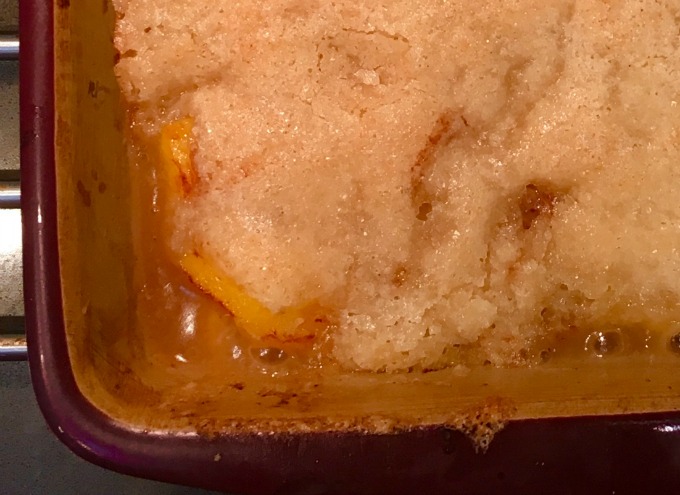
Serve warm plain or with frozen ice cream of choice. I personally like it served up with a little bit of coconut milk if I don’t have any dairy free ice cream on hand. My husband tells me it’s delicious with vanilla ice cream.

Gluten and Dairy Free Peach Cobbler with vanilla icecream

This recipe works great with using brown rice flour, or almond flour. After trying both, our favorite is the almond flour version.

Careful, it’s addicting and you might want to eat this entire dish of gluten and dairy free peach cobbler.

NOTE:  Cobbler can be made with canned peaches, but it is always best made with fresh picked peaches from your peach trees from Western Gardens.  Fall is a good time to plant trees.

Gluten free peach cobbler. Dairy free peach cobbler.

Filed Under: Eat from Garden - Recipes, Recipes, Tips & How To's Tagged With: dairy free, gluten free, peach cobbler, recipes from the garden

Planting New Trees 101- Secrets to Help Your New Tree Thrive!

July 26, 2017 by Vanessa Roush

Welcome Friends! Glad you dropped in.


In Utah, spring and fall are the best times for planting new trees.  Here are a few secrets to help you find success with your new investment that will beautify and make your yard and home more enjoyable for a long time.

Planting New Trees Begin With Buying an Appropriate Healthy Tree

The first step to a healthy tree is to purchase from a quality local independent garden center or nursery. Big box stores tend to get trees that look okay for a season but suffer down the line because of poor soil, crowding, root chopping, inadequate root ball size, rough handling, and poor care.  Often these warehouse stores don’t own the plant inventory; it is on consignment, so less care is given to the material.  A local independent store, like Western Gardens, also has experts who can help you pick the right tree for the conditions at your house and your growing Zone. Check for trees that have 10’’-12’’ of root ball per inch in diameter of the tree trunk. When selecting a tree, take into account the mature height and width. Material from a quality grower usually has a tag indicating the mature height of the tree.  Some trees may look cute now planted a few feet from the house and close to another one, but after a few years this can become very problematic. Also consider planting a tree of an underutilized species in your area.

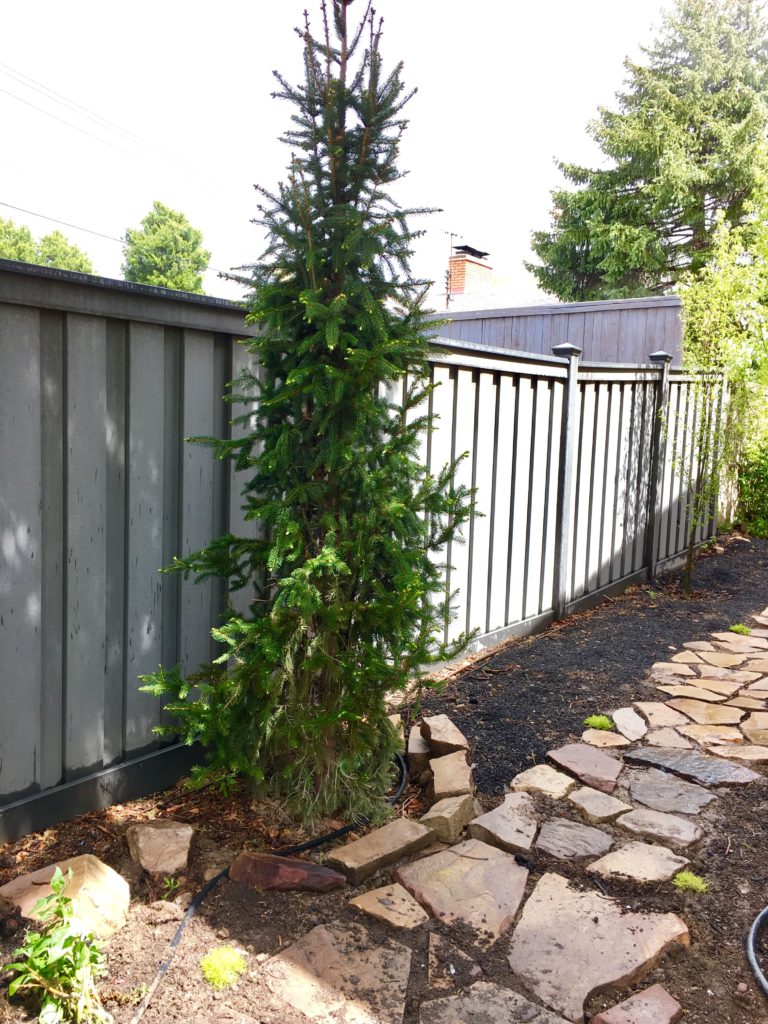
Planting new trees can be easy and satisfying.

Transport Your New Tree Home

Local independent gardening stores can deliver your tree for a nominal fee, and you can have the peace of mind knowing that it was transported carefully. If you are transporting your tree home yourself, make sure that it is properly secured and avoid going on the freeway or driving at high speeds. It’s preferable to transport them on their side in the back of a truck so that the leaves aren’t taking the brunt of the air flow as you drive. This can desiccate the leaves and put the tree into shock. As the tree is lifted in and out, be careful to handle gently. Dropping or rough handling can also put your tree into shock.

Evaluate the Branching of Your Tree and Decide Which Way It Should Face

This is often an overlooked step, or an after thought most of the time. Every tree has different branching and some have a better side than others when it comes to aesthetics. First place the tree in the spot where you’d like to plant it and turn it until the branching is how you like it . Take a few steps back, walk around, and look at it from different viewing angles. Consider the main viewing point for the tree, or other things like proximity to fences, driveways, side walks, and power lines.

Evaluate the branching of the tree before planting new trees.

Dig the Hole and Fill with Water

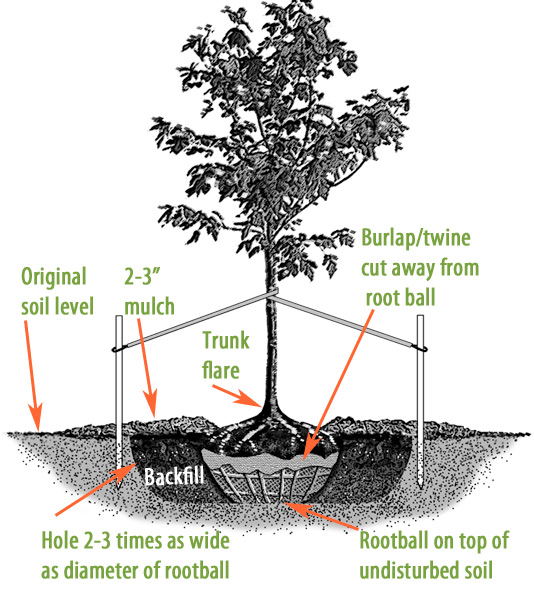
Dig the hole twice as wide and twice as deep at the root ball. If you are planting a tree that likes well drained soil, but you have clay soil, then be sure to dig the hole much wider and supplement with some good soil.  Bumper Crop mixed in with your soil is one of our favorite recipes.  The hole should not be deeper than the root ball itself.  Use your hose to fill the hole with water and let soak down a bit.  This insures that there will be good moisture deep down for the roots of your tree to take hold.

Planting New Tree in Hole – Rotate and/or Straighten

If your tree came out of a bucket, check to make sure the roots are not root bound, or circling around itself. If they are, take a razor blade or knife and cut an X on the bottom and make 4 cuts along the sides. If it was wrapped in burlap and/or with twine, remove any plastic twine because this will not decompose. Loosen the burlap.  These steps are important so that the roots do not become wrapped around itself causing the tree to girdle itself and die.  Place the tree in the hole and backfill it around the sides. Around the trunk, mulch can be 1’’ thick and then increase in depth up to 4’’ toward the outer edge of the rootball. Check and make sure the tree is straight. Also make sure that you can see the flare of the trunk; it should not be covered.

http://www.gardeners.com/how-to/tree-planting/8741.html

Image Credit: Gardeners.com

Watering A New Tree

Planting new trees into the ground isn’t the end.  Watering is very important.  The amount of water varies on the type of tree and soil conditions at the planting site. If you are unsure, ask your local gardening expert. Trees should be watered when planted and also the following day. Then follow with every 3 days or so. The first 2 years of the tree’s life are the most important for establishing roots. When you water, try to do a slow drip so that it can soak down deep and encourage deep roots. Some sprinkling systems may provide adequate watering, but try to avoid high pressure sprinkler heads from spraying the trunk of your tree. It’s not necessary to fertilize trees during their first season.

Monitoring Tree Growth and Health

Don’t forget to monitor the health of your tree as time passes by. If you notice the leaves or needles look sick, take a sample of the problem or at least a photo to Western Gardens where their experts there can diagnose most problems just by examining your sample. They can give you suggestions for chemical and/or organic methods to resolve the issue.

Planting new trees is a wonderful experience because you are investing in the future.

Filed Under: Gardening, How To, Tips & How To's, Trees, Utah Gardening Tagged With: fall planting, planting new trees, Planting trees, Planting trees in the right spot, spring planting, tree planting, Utah gardening

Harmful Garden Insects: Organic Management

July 18, 2017 by Marjorie Carter

 Welcome, Friends! Glad you’re here for some tips to organically manage those pesky harmful garden insects so you’ll have produce left to harvest!

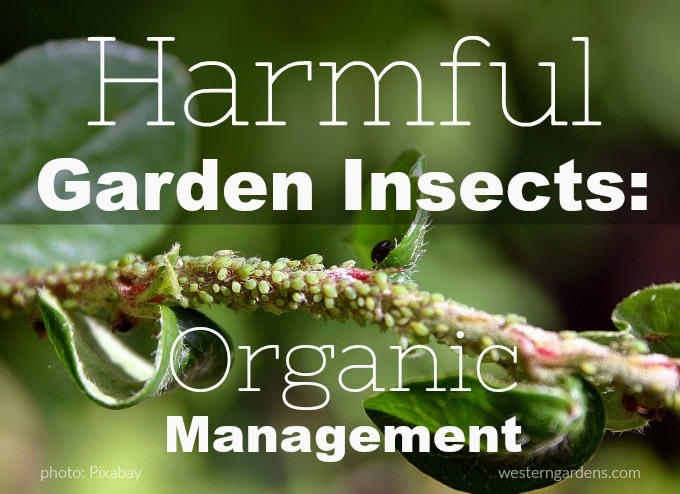
Harmful garden insects can be managed organic methods

All yards and allotments will have harmful garden insects every year; it’s part of nature.  These insects need to eat in order to feed the beneficial insects.  Eliminating ALL the harmful insects from your garden would be time, labor, and resource intensive. You also run the risk of depleting the food source for beneficial insects and other animals that feed on the harmful critters.

Wise Goal – An important and wise goal is to control the harmful garden insects enough to reduce the damage to your garden to a manageable level.  Meaning that by harvest time, there is something left for you to eat.  Losing one or two tomatoes is manageable and probably hardly noticed, but an entire decimated crop means there’s a problem to address. 

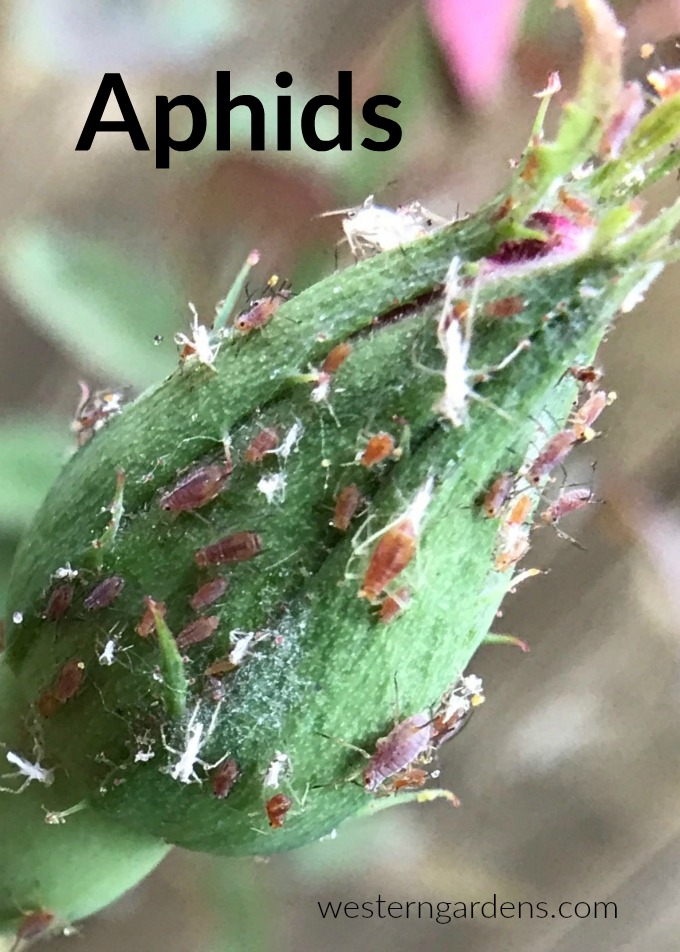
aphids are harmful garden insects that can be easily controlled

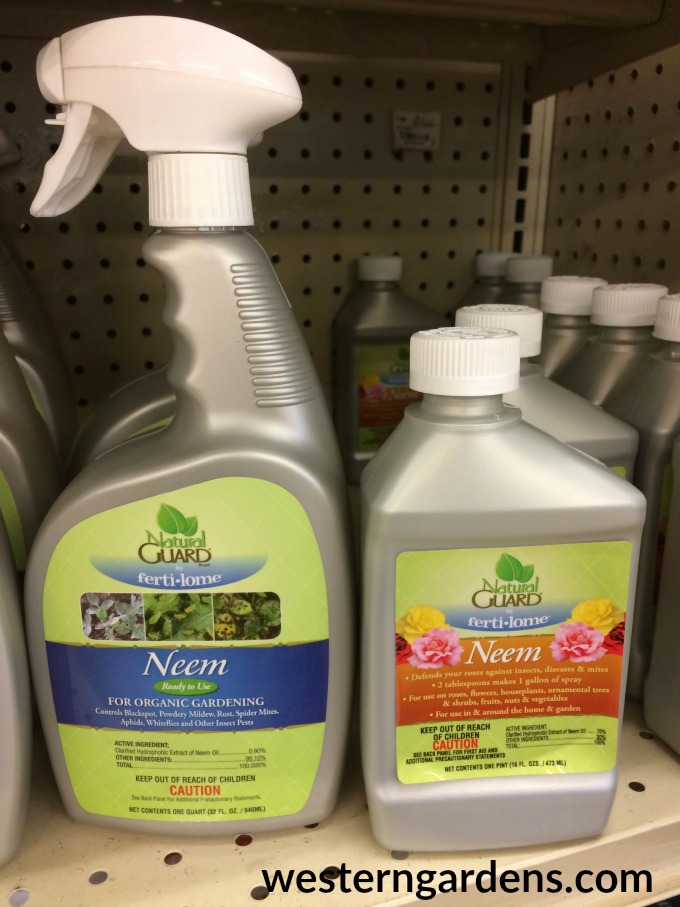
Aphids – One year we had aphids on our herbs which was easily treated by spraying the affected plants with neem oil, a wonderful organic product found at Western Gardens.  This significantly reduced the number of bugs.  They were further kept at bay by some helpful ladybugs, also found at your garden shop. 

Neem Oil is safe organic product. Read label

We were careful to thoroughly wash our herbs before eating them to remove any remaining aphids. Washing anything you harvest before eating it is always a good idea anyway.

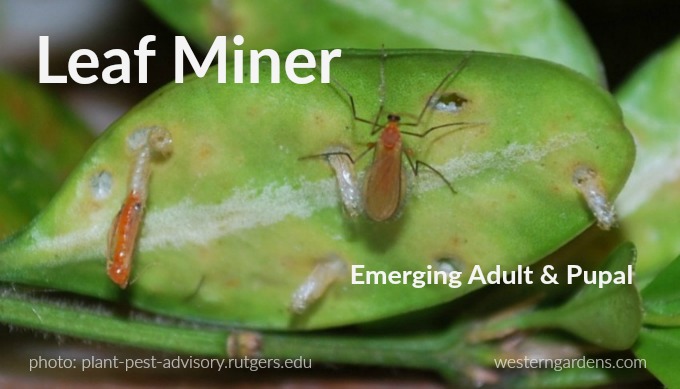
Harmful garden insects include the Leaf Miner

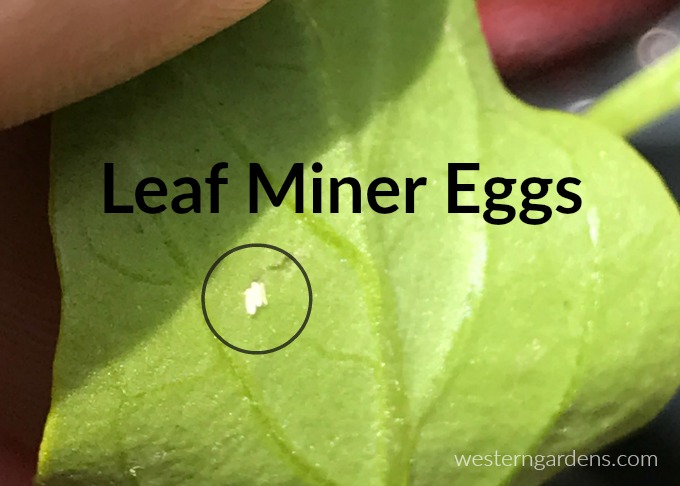
Leaf Miner – Last year, our challenge was leaf miner larvae on our Swiss chard.  In this case, we simply discarded any leaves that had been extensively chewed.  Otherwise, we snipped off the parts that didn’t look as appetizing, like anything that had a visible egg attached to it (usually on the underside of the leaves), washed everything, and then enjoyed our tasty green salad.

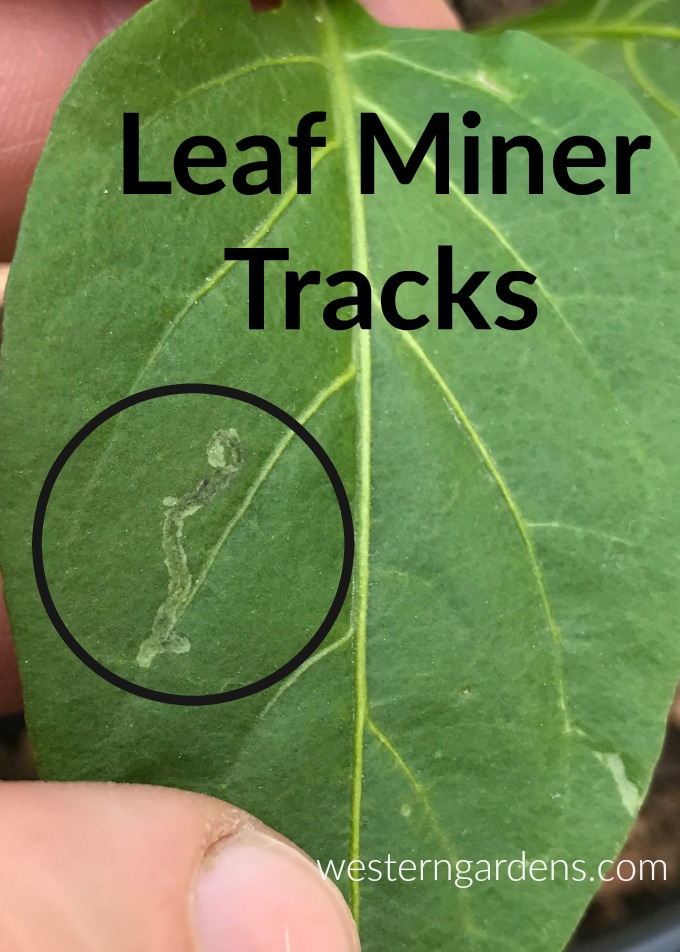
tracks of leaf miner on pepper plant leaves

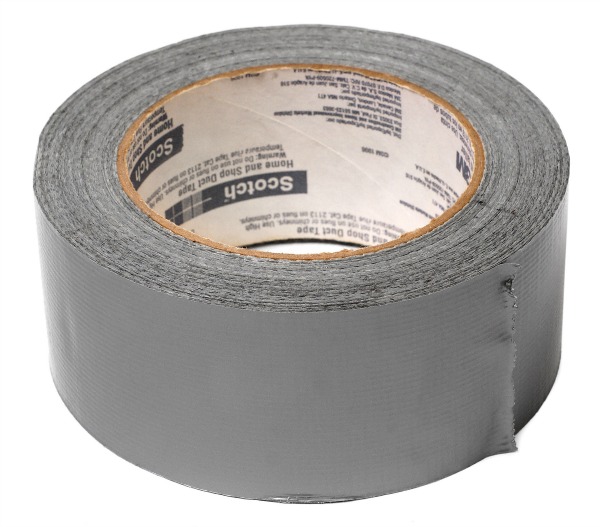
This year, now that we know to look for the leaf miner eggs on the leaves, we were more attentive with our starts for our garden and inspected them daily, looking for them or other harmful garden insects.  We found eggs on our pepper plants and did our best to remove them when the plants were small.  We used a piece of duct tape wrapped around a finger to remove the eggs.

duct tape wrapped around one finger helps lift off insect eggs from plants

We found that using a gentle fingernail was still too rough for the tender young leaves, so gently touching the tiny eggs with the sticky duct tape easily lifted them off.  

Eggs of the leaf miner on pepper plants

Once the plants were more mature and could withstand a little insect activity, we were less vigilant at egg removal, but still mindful of looking for eggs once in a while.  Read more on homemade remedies for treating leaf miners by clicking here.

harmful garden insects also include squash bugs

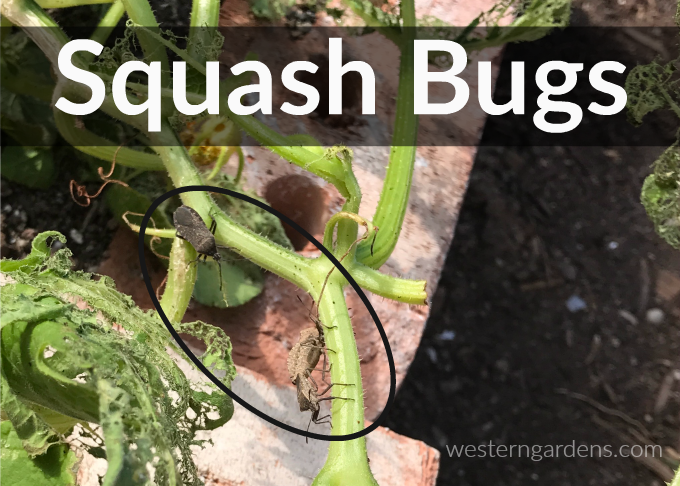
Squash Bug – This year, we planted pumpkins for the first time.  We had heard of the dreaded squash bug and had been looking for them but hadn’t seen any damage to the plants.  Then, just last week (late June), one of our pumpkin plants was nearly devoured overnight by something.

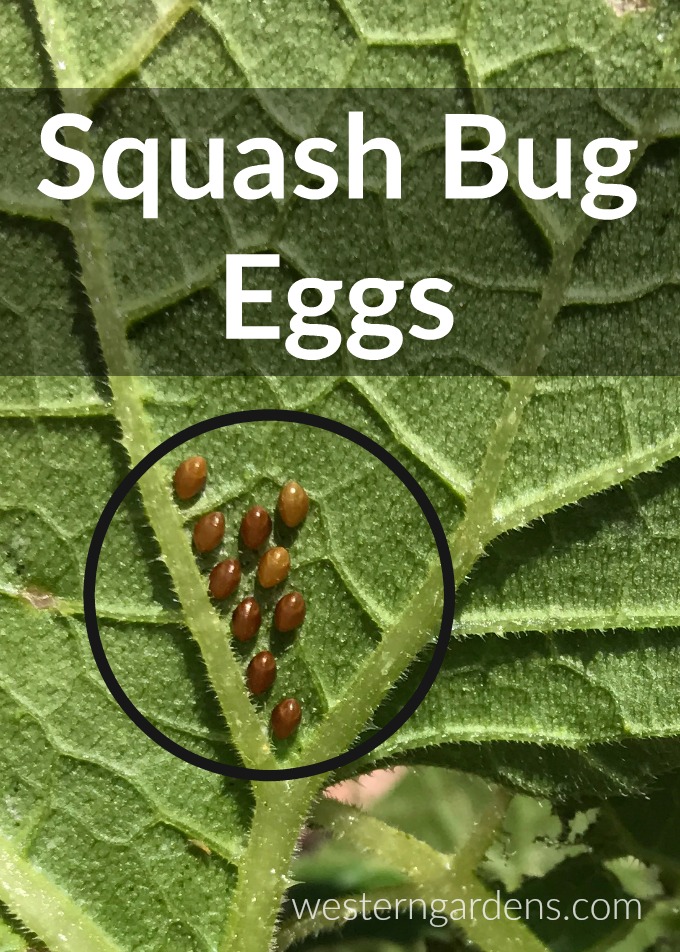
Squash bug eggs are easy to spot and remove.

We assumed it was the infamous squash bug.  This assumption was reinforced when, upon closer inspection of the plant, we found a mating pair of squash bugs with a third one waiting on the side-line and eggs attached to the underside of the remaining leaves and the stem. We posted photos of the damage to a Facebook gardening group and learned of some other likely culprits.  That night my husband went out with a headlamp and a bottle of neem oil to investigate.

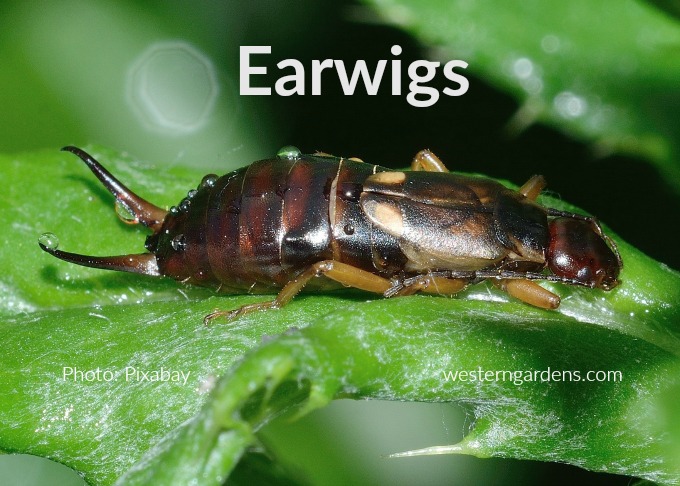
earwigs are harmful but also beneficial

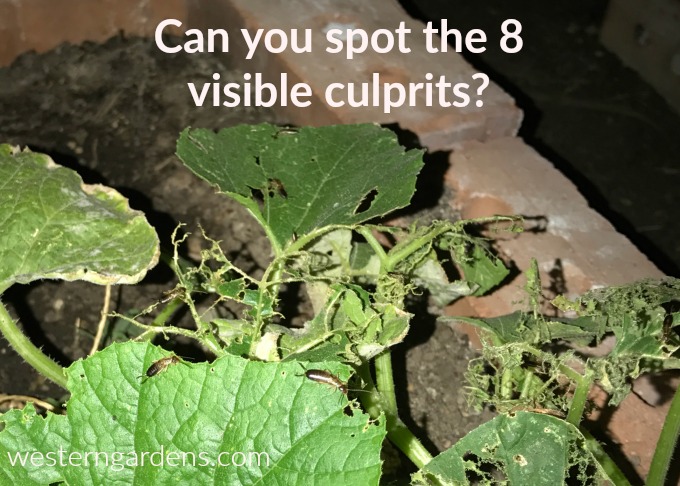
Earwigs – Someone suggested the damage looked like the work of earwigs.  My husband found several earwigs eating on the plant and a swarm of them hiding in a nearby crevasse. Earwigs are a complicated insect in the garden.  They are not only harmful, but also beneficial.  They aid in breaking down organic matter (composting) and they also eat aphids and other harmful insects. However, when there are too many of them around a young susceptible plant, they can be very destructive.  We could also see evidence of earwigs damage on a few leaves of nearby tomato plants.  This minimal damage doesn’t pose a risk to a plant that has hundreds of leaves to perform.  In comparison, the pumpkin plant had only a dozen leaves to start with and most of those were very damaged. 

earwigs eating pumpkin plant leaves

My husband sprayed neem oil on the earwigs on the plant, in the swarm nearby, and even in their nest. It’s still uncertain whether the plant will survive though it already shows signs of new growth. We monitor it closely to prevent another insect attack that would probably kill it.

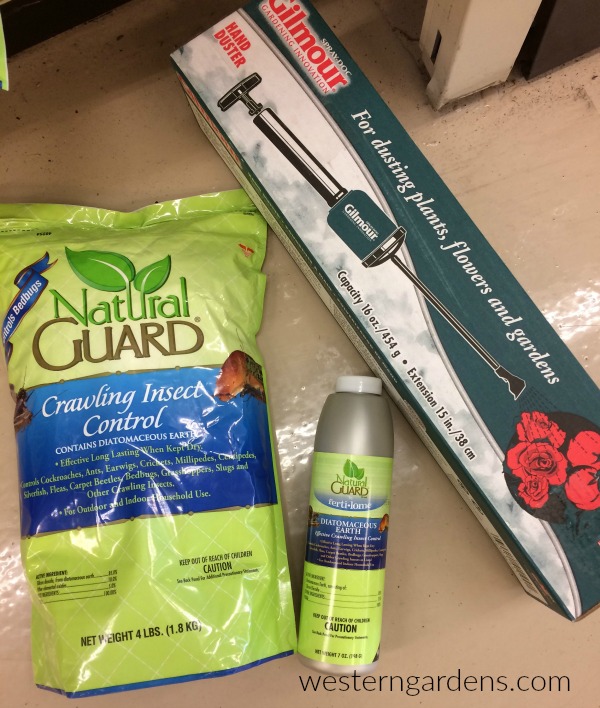
Another organic alternative that works to kill earwigs is diatomaceous earth, which also now offers a nice dispensing bottle which helps cut down on waste and mess.  Check it out at Western Gardens.

diatomaceous earth is a natural organic product to control crawling insects in the garden.

As for the squash bugs, not the main culprits to the pumpkin plant, they were probably snacking on it also.  We’re still removing eggs as we find them (using the duct tape trick mentioned above) and killing any adults.  Their numbers can quickly get out of hand. Again, diatomaceous earth works well to control squash bugs.

Beneficial vs Harmful Insects – Lady bugs, praying mantis, and birds are a few examples of creatures that feed on the harmful garden insects; hence, we like to see these around around the yard.  When considering how to handle any harmful garden insects, the first reaction should generally not be total annihilation.  Rather, try to reduce their numbers and also allow the beneficial insects and animals to do their part until the plant is mature enough to withstand the damage. 

Good luck and happy hunting!

CLICK HERE to read about beneficial insects you want in your garden.

10 beneficial insects you want in your garden! If you spot these in your yard, you're in good shape!

Filed Under: Flowers, Gardening, How To, Insects, Tips & How To's, Utah Gardening, Vegetables, Veggie Gardening, Yard Care Tagged With: Gardening, harmful garden insects, harmful insects, How To, organic management, organic pest controls, Utah gardening, Western Gardens

Fresh From The Garden Gift Tags

July 12, 2017 by Jenn Crookston

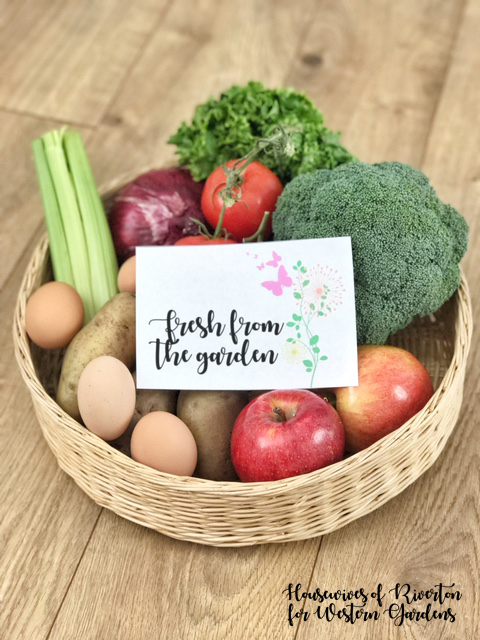
gift tags for garden produce for neighbor gifts
We’re heading into the very best time of the year when it comes to fresh fruits and vegetables.  If you’ve got a garden you know how quickly, once things start to ripen, you can end up with lots of extras.  These Fresh from the Garden gift tags may be incentive to get out and share your joy!

I have loved sharing my bounty with friends and neighbors over the years.  It’s always nice when something I’m not in need of brings a smile to someone else’s face.

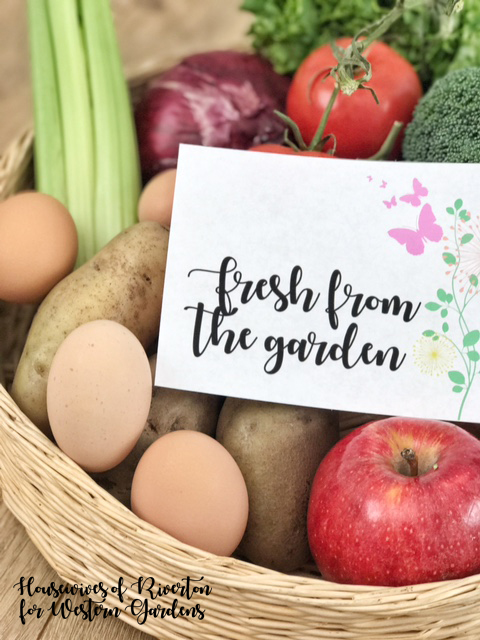
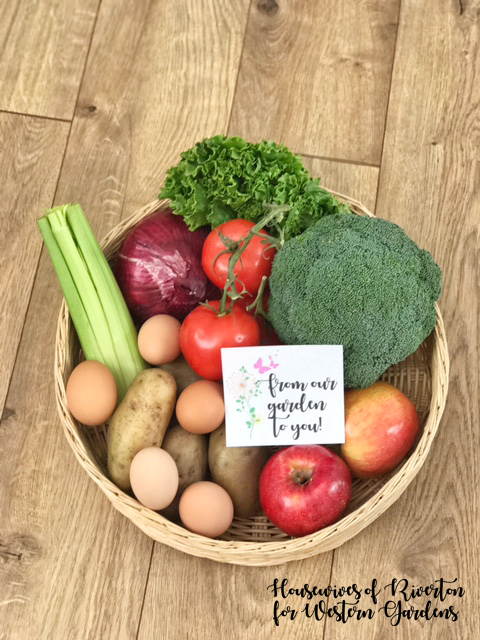
July 15th is National “Give Something Away” Day.  I created these bright “Fresh from the Garden” and “From our Garden to You” printable tags to celebrate this fun day.  Grab a small basket (or large, depending on your bounty), fill it with garden fresh fruits and veggies, print off a cute tag and deliver to one of your favorite people.

This would also be a cheerful tag to use with a fresh loaf of zucchini bread or other garden fresh treat.
Ready to print garden gift tag for giving fruits and vegetable away from your garden.

Click HERE for the Fresh From the Garden tag.

Garden gift tag "From Our Garden to You!" - ready to print

Click HERE for the From Our Garden to You tag.

I think sharing is one of my favorite things about having a garden (and having chickens, I love sharing fresh eggs).  In the past, a few neighbors and I were very intentional with our gardening.  We looked at the things we knew we wanted to grow and used a lot of and then sort of split up the planting.  Why would everybody in the neighborhood plant zucchini plants when we knew a couple well maintained plants would supply more than enough for us all.  Same with tomatoes and cucumbers.  As I’m trying my hand more at canning having a couple plants each of my own has been awesome and there is still plenty to share.
Fresh from the garden gift tags to use on a basket of produce for someone in need.
I hope you take advantage of National Give Something Away Day this July 15th.  Remember while these fresh from the garden and from our garden to you tags are created for you to gift something from your garden this is also an opportunity for other ways to give something away.

Give Something Away Idea – Go through your home, find those items that are still in good repair that are just not being utilized by you or your family, then donate them as well!

Give Something Away Idea – Put together your own little farmer’s market where neighbors can gather and share their bounty.

Give Something Away Idea – Create a little swap-n-shop where people can bring things they no longer need and look through things others have brought that might be a perfect fit in their home.

You can download the free printable tags here and here.  We’d love to see how you use them!
Happy Summer!!

Filed Under: Crafts, Gardening, Holidays, Tips & How To's, Utah Gardening Tagged With: DIY, eat your garden, fresh produce gifts, garden gifts, Gardening, national holidays, tips, Utah gardening, Western Garden Centers

June Gardening To-Do List

June 8, 2017 by Western Gardens

Welcome gardening friends!  So glad you stopped by!

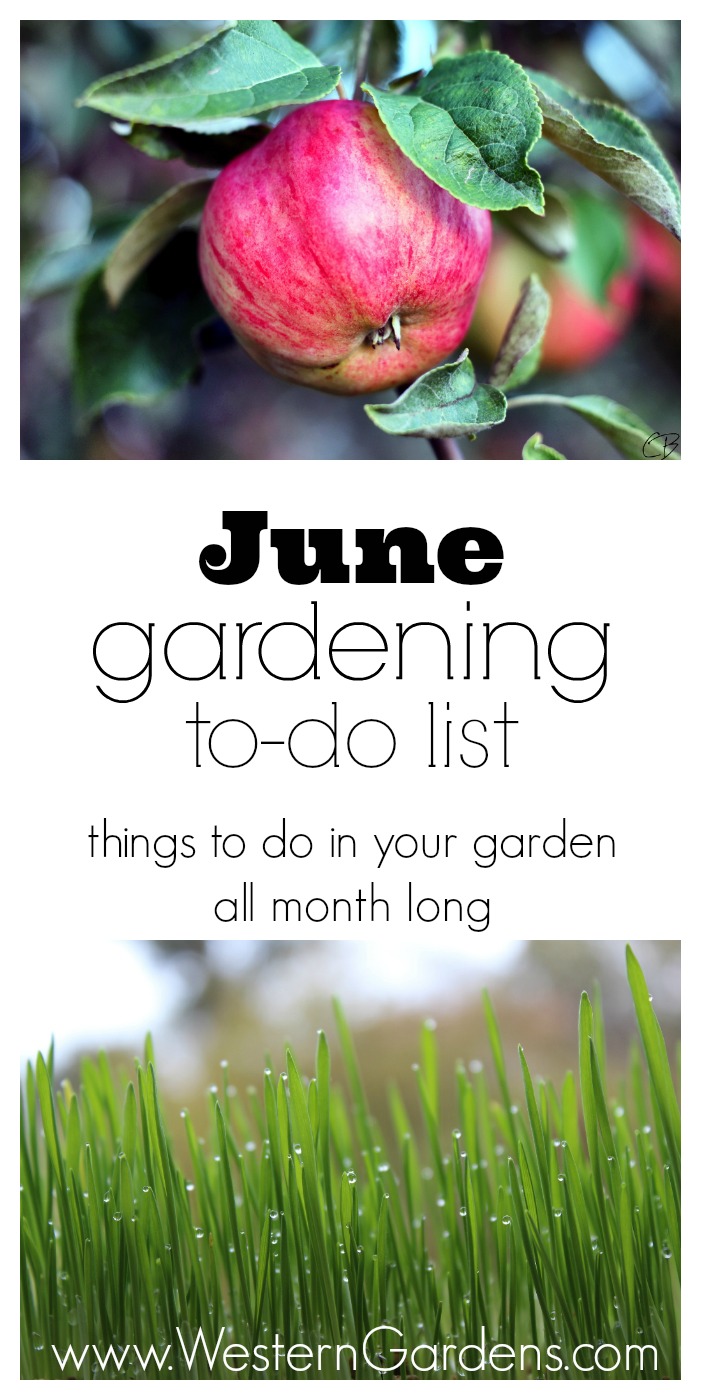
Not sure what to do in your yard & garden this month? Check out our June to-do list on www.westerngardens.com

Do you love to work in your yard, but aren’t sure of all the things you should be doing?  Then you’re in luck!  We’ve put together a list of things to do in June!

Not sure what to do in your yard & garden this month? Check out our June gardening to-do list on www.westerngardens.com

You may not need to do everything on this list.  For example, if you don’t have a cherry tree, you won’t need to worry about treating for Cherry Fruit Flies.  Just pick what applies to your yard and plan out when you will do it all throughout the month!

June Gardening To-Do List

➺Plant shrubs, trees and evergreens

➺Fertilize vegetables every 4 weeks with a slow-release fertilizer, and
fertilize roses

➺Watch For Insects show a sample in a clear plastic bag to a garden expert if you suspect a problem

➺Fertilize Lawns and apply iron sulfate if needed (to green up your grass)

➺Watch For Insects like grasshoppers, potato bettle, squash bug & spider mites.  If you suspect a problem, take a sample in a clear plastic bag to a garden expert.

➺Thin Out fruit trees for a better yield

➺Control Powdery Mildew on apples, apricots, cherries, peaches, nectarines,
grapes, peas, roses & euonymous

➺Treat For Cherry Fruit Fly when cherries begin to turn pink, unless already
using fruit tree spray

➺Control Peach Twig Borer once a month with spinosad

➺Watch For Slugs & Snails control with bait or other techniques

➺Adjust Sprinklers if needed, for increasing heat

➺Move And Replant Bulbs if the foliage has died down

➺Watch For Lawn Insects and treat as necessary

➺Prune & Fertilize flowering shrubs

➺Watch For Signs Of Lawn Disease take a sample to a garden expert if you
suspect a problem

➺Control tobacco budworm on geraniums & petunias

➺Control Weeds before they set & disperse seed

➺Plant Outside
Until June 15th: carrots & endive
Until July 1st: cauliflower, parsley, swiss chard, rutabaga
Until July 15th: beets & broccoli
Until Sept 1st: radishes

*This is not an exhaustive list.  If we’ve overlooked something important, feel free to leave a comment and we will add it to the list!

If you’re local to the Salt Lake area, come in to any of our locations with questions or samples!

Not sure what to do in your yard & garden this month? Check out our June to-do list on www.westerngardens.com

Filed Under: Gardening, Tips & How To's, To-Do List, Utah Gardening, Yard Care Tagged With: Gardening, How To, June gardening to do list, lawn, Lawn Care, tips, Utah, Utah gardening, utah gardens, Western Garden Centers, Western Gardens

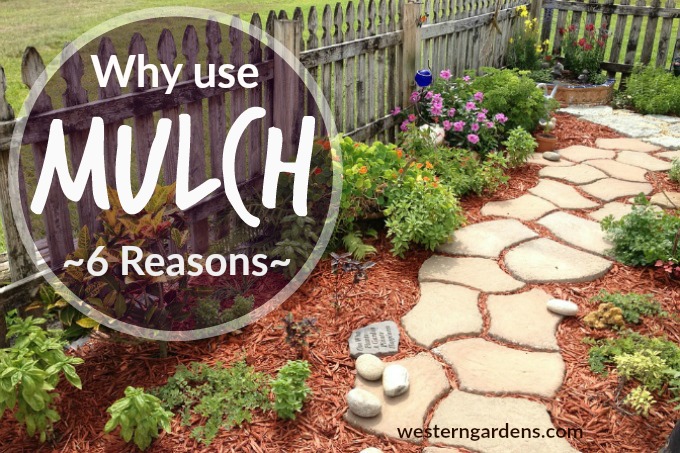
Marvelous Garden Mulch

May 12, 2017 by Heather Leister

Welcome, Glad you stopped by!

Garden mulch makes a yard look well kept, but there are other excellent reasons why it is good to lay down a layer of this simple garden basic.

Reasons to use mulch in your flower beds

If you give me the choice between spending a Saturday working in the house or working in the yard, I will choose my yard every time. The reason? For me, there is something deeply satisfying in pulling weeds and neatening up flower beds. Yes, I know that the weeds will eventually grow back, but it takes them longer to return than it does the messes in my house. Those will reappear before the day is over!

After I finish weeding my yard, I like to put down fresh mulch. Not only does it make everything look tidy, it’s an important step in taking care of the yard. Mulch provides several key benefits for your yard. If you’ve never put it down before, consider the following benefits that it offers.

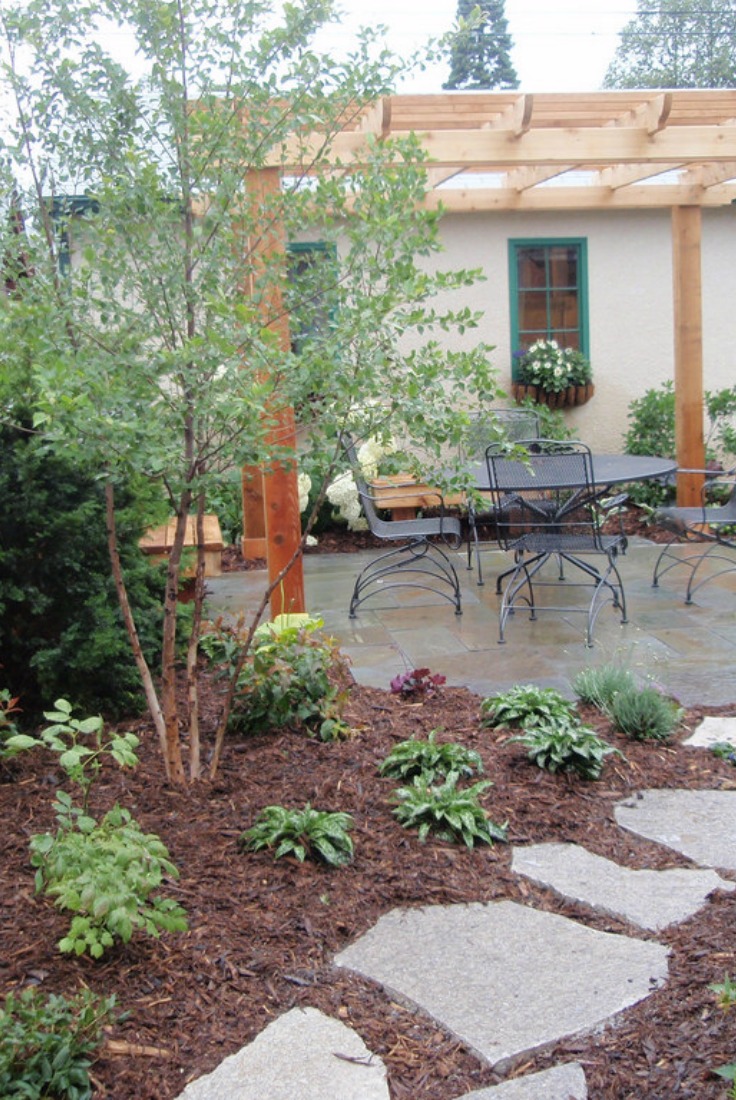
Mulch under perennials and stepping stones for a finished look

Image credit: Flickr

Weed control: A layer of mulch on your flower beds and around your trees will prevent weeds from germinating and growing.

Moderates soil temperature: Mulch will help prevent the temperature in your beds from fluctuating between too hot and too cold. It’s a good idea to apply your mulch after the soil has had a chance to warm up.

Retains moisture: Mulch prevents moisture from evaporating out of the soil. This benefits plant roots and leads to healthier growth.

Prevents erosion: Mulch will also prevent soil from eroding when it rains. When it rains the water hits the mulch first and keeps the soil from washing away.

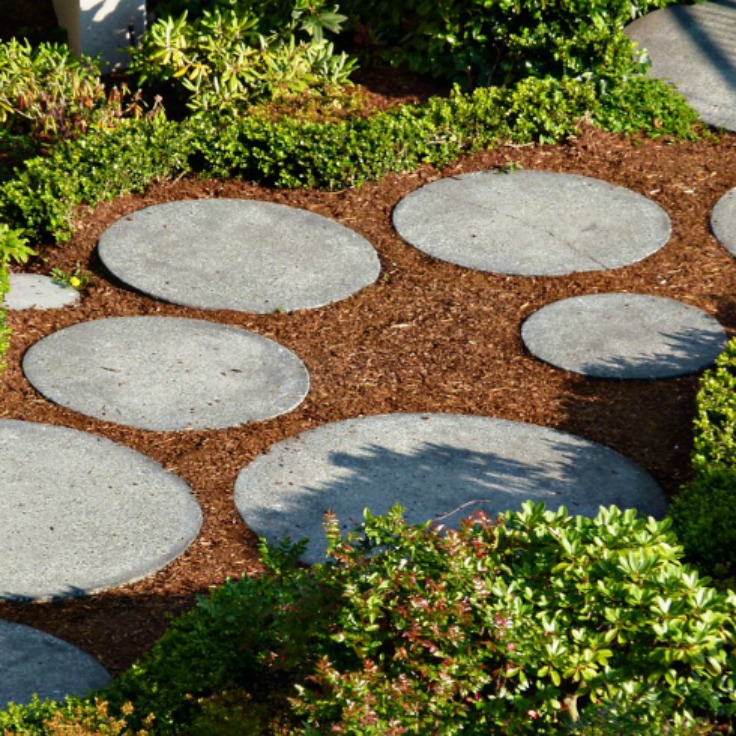
mulch and stepping stones

Image Credit: Pixabay

Adds nutrients to the soil: The definition of mulch is anything that you put down on your soil, but if you choose an organic mulch you will have the benefits of adding nutrients to your soil as your mulch decomposes. Even if you don’t select an organic mulch, the layer will prevent the soil’s nutrients from washing away.

Curb Appeal: Mulch gives your yard a polished look and the choices are endless. I prefer the look of a dark mulch, so we tend to use dark organic mixes that will decompose in our flower beds and around our trees. Other possibilities are rocks, compost, bark, wood chips, landscape fabric, or recycled rubber tires. Whatever you choose, pick something that complements your landscaping and gives your yard a finished look.  Western Gardens has a variety of quality mulch products to recommend.

Light colored mulch for a flower bed

Image credit: Pixabay

Filed Under: Gardening, Tips & How To's, Yard Care Tagged With: flower beds, Mulch, Utah gardening, why use mulch, Yard Care

DIY Porch Planter Box for Mother’s Day

May 7, 2017 by Jenn Crookston

Welcome – Glad you dropped in for a great idea!

Mother’s Day is just around the corner and I’ve got the perfect Mother’s Day gift that you’ve got plenty of time to create because it is such a fast build.  Your mother/wife/friend will love this DIY Mother’s Day Porch Planter Box.
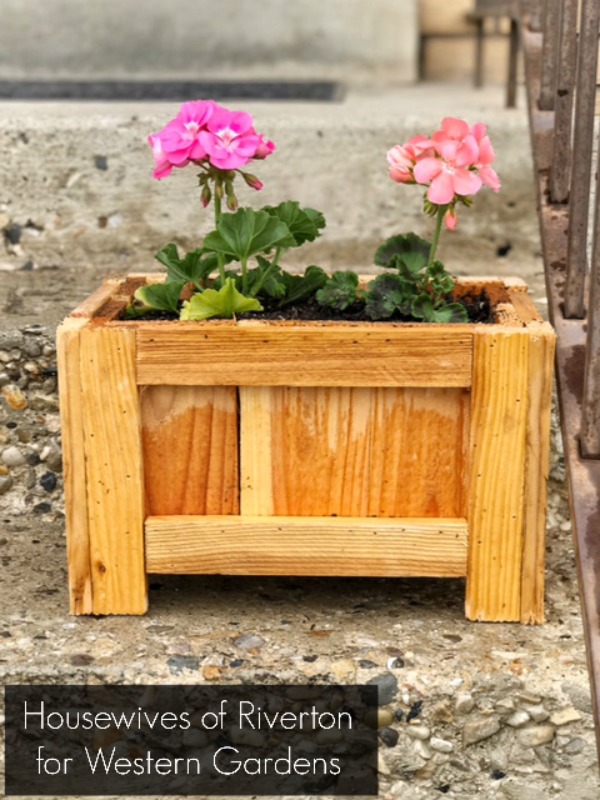
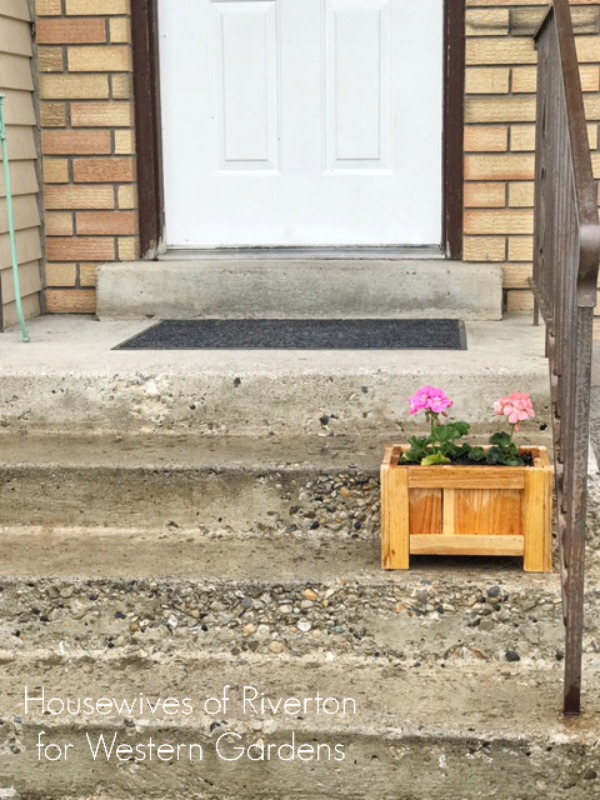
Geraniums in a planter box for your porchI’m pretty sure it’s a proven fact that anything is automatically cuter when it’s small.  That fact holds true with this Mother’s Day Porch Planter Box.  I am completely smitten with how cute it looks sitting on my steps and can’t wait to make it a couple of sisters.  You’re going to love me when I tell you how easy this was to make too.
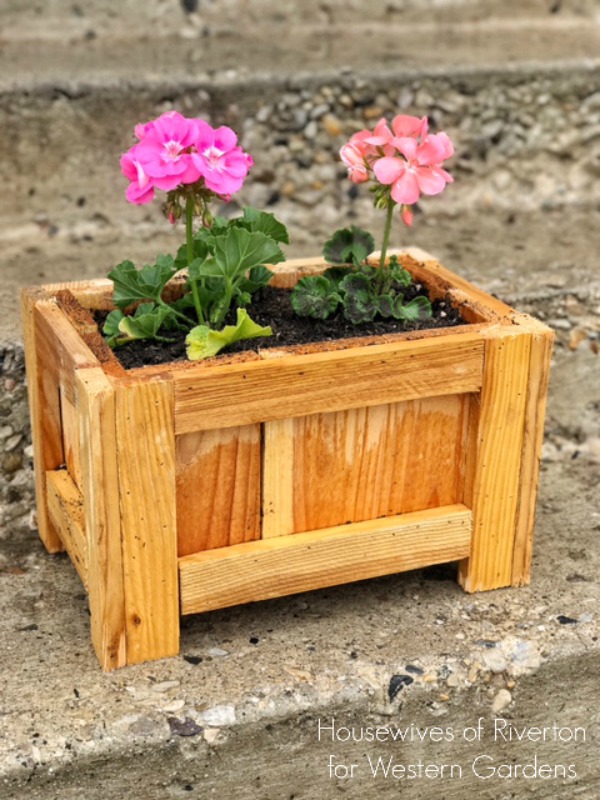
Because I wanted this planter box to be able to sit on a single step on my porch I needed to find materials that weren’t big and bulky.  After walking around the home improvement store for a while and looking at the different options I went with wood fencing and stakes.  Since both of these items are made to be outside in all weather conditions I figured they were perfect for this project and they aren’t bulky pieces of wood which means more room inside the box for flowers.
Here is a good photo of the box assembly.  The fencing is less than $2 a board and the stakes we had on hand but I’m pretty sure were around a dollar each.  I used just over 1 fencing board and 2 stakes for one box.  I think with 4 boards and 7 stakes you could make 3 planter boxes, including nails I think you’re looking at 3 planter boxes for under $20, pretty awesome if you ask me!
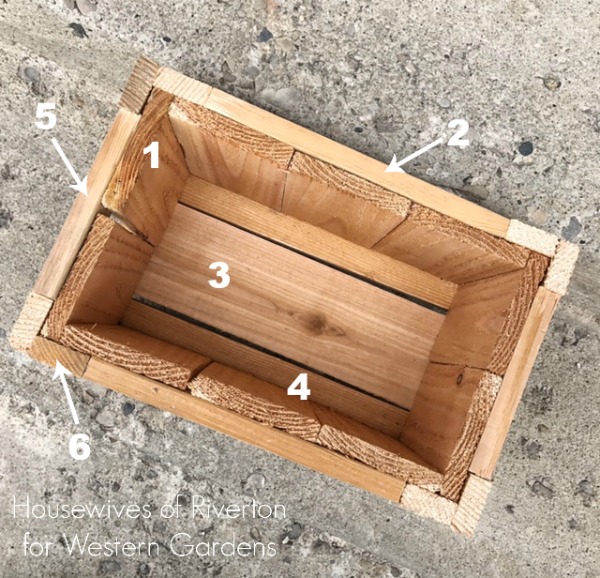
construction of DIY porch planter box for mother's dayI used our miter saw to cut my pieces, if you don’t have a saw at home here is your cut list and the people at the home improvement store can cut them for you.
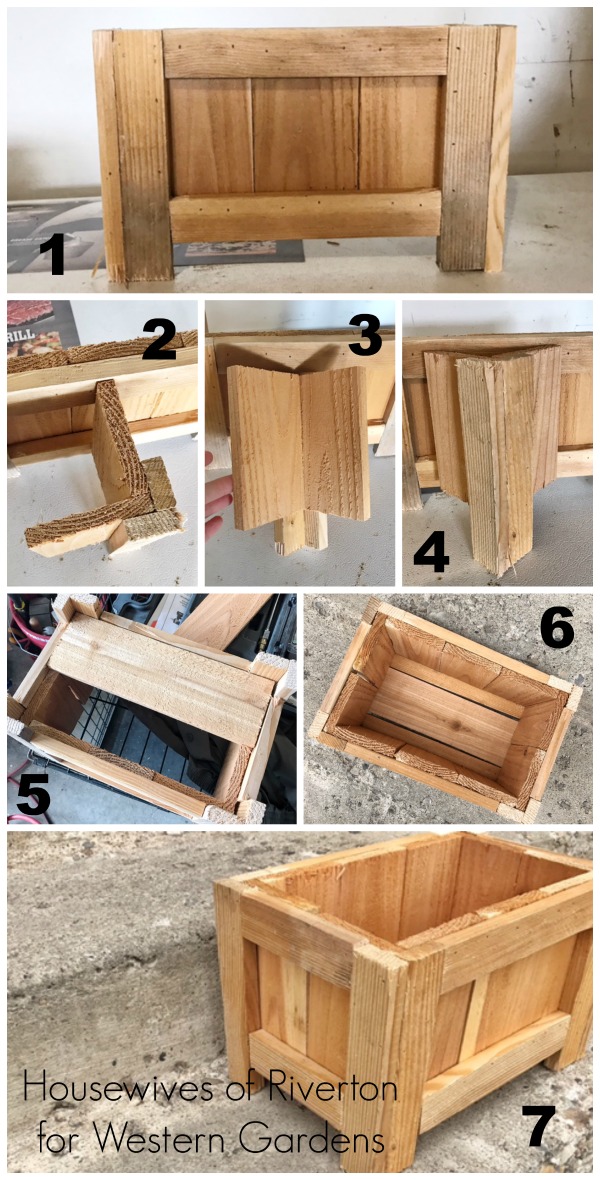
Cut List:

10 #1 (side pieces) – 3.5″x 6″
4 #2 – (long side braces) 1.4″x 8 5/8″
1 #3 – (middle bottom) 3.5″x 11.5″
2 #4 – (side bottom) 1.5″x 11.5″
2 #5 – (short side braces) 1.5″x 5 1/4″
8 #6 – (corners/legs) 1.5″x 8″

Porch Planter Assembly:

I used a brad nailer to create the box with 1″ finish nails.  If you don’t have a nail gun you can use tiny nails and a hammer to create the box it’ll just take a little more time.  These nails are perfect because they’re easily painted over and hidden if you choose to paint your planter box.

To create my planter box I started by creating one side as shown in photo 1. 

Once I got that side done I created the corners as shown in photos 2-4.

When I had the corners done assembly was easy.  I placed the side brace against one corner piece and then nailed into place.

When it was attached I then placed the next side piece in place and attached it to the side brace.

Photos 5 and 6 show the bottom of the planter box.  As you can see in photo 5 there isn’t quite enough room for 2 pieces of fencing on the bottom.  Photo 6 shows how perfect once piece of fencing and two pieces cut from a stake fit leaving enough room between the pieces to allow water drainage.

As you can see in photo 7 I wasn’t too worried about a perfectly smooth surface, you can sand and paint/stain as desired, I love the little more rustic look so this was perfect for me.
Planter box with living flowers on front porch stairs of houseCan’t you just picture a few more of these darling little planter boxes leading all the way up the stairs.  I can’t wait to get them all finished and filled with beautiful flowers from my local independent garden shop Western Garden Centers.
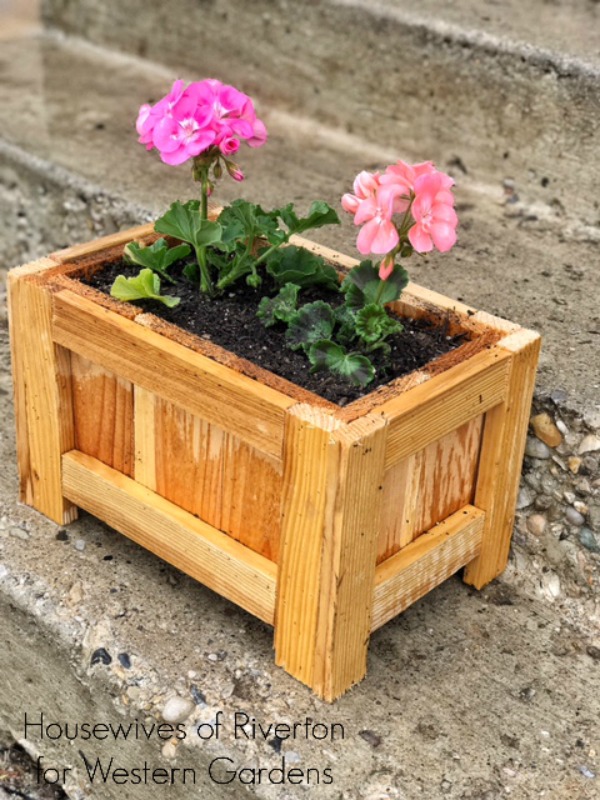
You can easily make this planter box and fill it with flowers for less than you would spend on a bouquet of cut flowers for Mother’s Day and they’ll last all season long and the planter for years to come.
western gardens have geraniums for your planter box

Filed Under: Container Gardening, Flowers, Gardening, How To, Outdoors, Tips & How To's Tagged With: container gardening, DIY, flowers, mother's day gift idea, porch planter, simple gift

Differences between Perennials and Annuals – What’s Best for My Garden?

May 5, 2017 by Becky

WELCOME FRIENDS, Come learn with us!

difference between perennials and annuals

image: Pixabay

As a novice gardener, I need to know what is the difference between perennials and annuals?  Whenever I went to the nursery, I was confused by the terms “annuals” and “perennials.”   When choosing plants for your garden it’s important to know the difference, so I thought I would share some of what has made it easier for me to remember.

Annuals

Annuals are plants that came from seeds earlier this spring.  You can plant them as seeds or you can purchase them as seedlings or starts in flats and pots.  Annuals usually bloom the entire summer until frost kills them.  They don’t survive the winter.  I remember the plants that are annuals because I have to buy them “annually.”

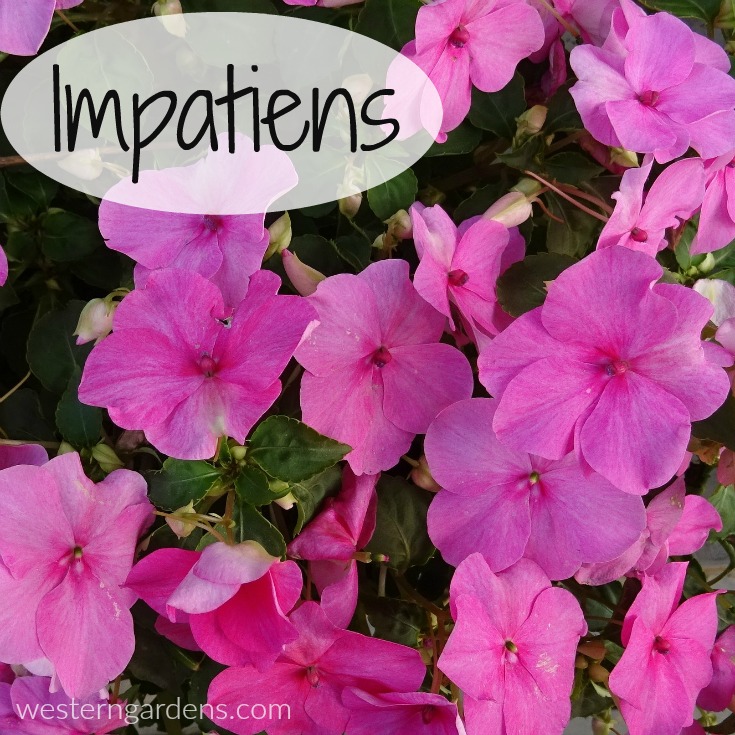
However there are exceptions, some tropical plants are perennial in a tropical climate, but in Utah’s colder climate, they are annuals.  They die every winter and need to be replanted as a new plant.  Geranium, Impatiens, and Bougainvillea are good examples of annuals.

impatiens are annuals in salt lake city

Image: Pixabay

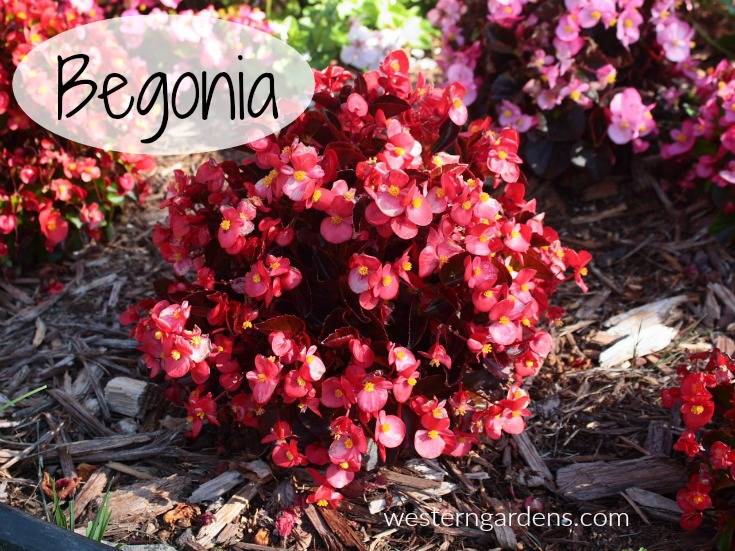
Begonia annual in Utah

Image: Pixabay

Perennials

Perennials that do well in our climate are a different story.  Perennials survive our Utah winters in the growing zone 5.  They bloom again year after year.  The tradeoff is that perennials have a definite blooming season and don’t bloom all summer long.  Usually they bloom from a couple of weeks to a couple of months.  There are many varieties from evergreen, to shade tolerant, or even drought tolerant.  Most die to the ground in fall or winter and spend most of winter dormant.  Most perennials like well-drained soil with plenty of organic material in it.

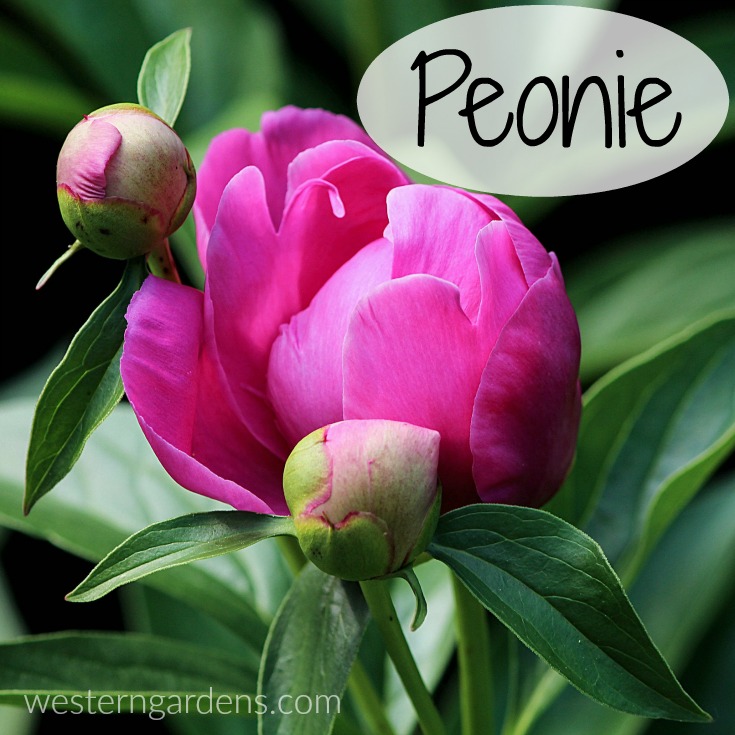
Peonie perennial in Utah

Image: Pixabay

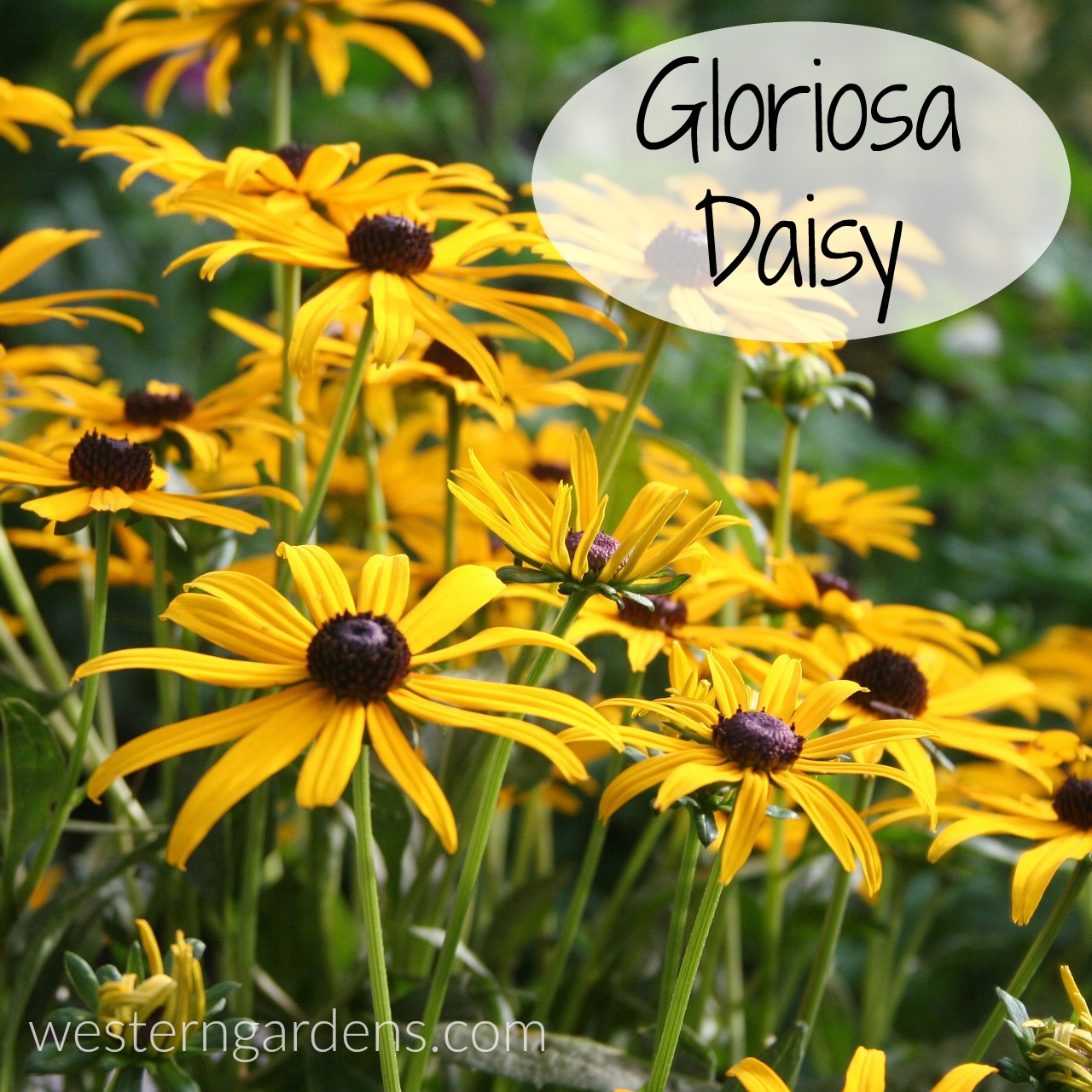
Gloriosa daily perennial

Image: Pixabay

So basically, that’s the difference between perennials and annuals. How long they survive in the climate zone you live in.  In the Salt Lake Valley, we are usually a zone 5, and sometimes can be a zone 6, so be sure and talk to one of our expert gardeners to make sure you get the perfect plants for your soil and landscape.

A Word about Placement

Placing a plant in a good site, in a place it will thrive, is one of the most important differences that will make your flower garden successful.  In my yard I have hot, sunny sites, cool shady sites, and everything in between.  I am always careful not to place a plant that prefers shade, like a Hosta, Fern, or Begonia in a hot sunny spot because it will do poorly.  A hosta in the sun will show it’s displeasure with burned, scorched leaves.  However, planting a peony, Petunia, or Sunflower in the shade will not produce good results either.  Any of our gardeners can help you identify which plants do best in sun, shade, etc.

A Word about Soils

Most soils in Utah are either clay or sand based (like my garden) and will do very well with some organic amendments.  For perennials create a 50/50 mix with existing soil.  For annuals simply spread a 2-3″ layer of organic amendment evenly on top of the existing soil, then dig or till it in.  The hole for perennials should be about twice as wide as the container and an inch or so less in depth.  Place the plant in the hole after popping it out of the container.  If it’s root bound (lots of white roots wrapping around the soil ball), use a short blade utility knife to make a few shallow, vertical cuts around the root ball to stimulate new root growth.  Press the root mass into the hole to make sure there are no voids under the roots and water well using a root starter (we can help you with that at Western Gardens too).

Come see us!

Our garden experts at Western Gardens have a lot of great suggestions to help you get your flower garden blooming all summer long.  From root starter to organic compost, we have everything you need.  Be sure to visit us on Facebook for specials and daily tips.

What do some of you expert gardeners do to keep your flowers strong and healthy.  Feel free to share your experiences here too.

Post revised by Wendy P 5/2017

Filed Under: Annuals, Flowers, Gardening, Perennials, Tips & How To's, Utah Gardening Tagged With: annuals, flowers, Perennials, planting flowers, utah annuals, Utah gardening, utah perennials

Plant Peas – Our Favorite Varieties

April 26, 2017 by Marjorie Carter

Our favorite garden varieties of peas from the gardenEach year as we get to the last few weeks of winter, my husband and I watch for the first day when it is warm enough for us to work outside in our garden for a few hours so we can plant peas.  We can’t wait to get them in the ground!  Though along the Wasatch front, we typically don’t plant until March, we’ve planted them as early as mid-February (straight in the ground; no greenhouse) and still had great success. Peas are a cool weather plant that needs little attention beyond watering and harvesting.  They tolerate snow and light frost so don’t be afraid to plant peas early.
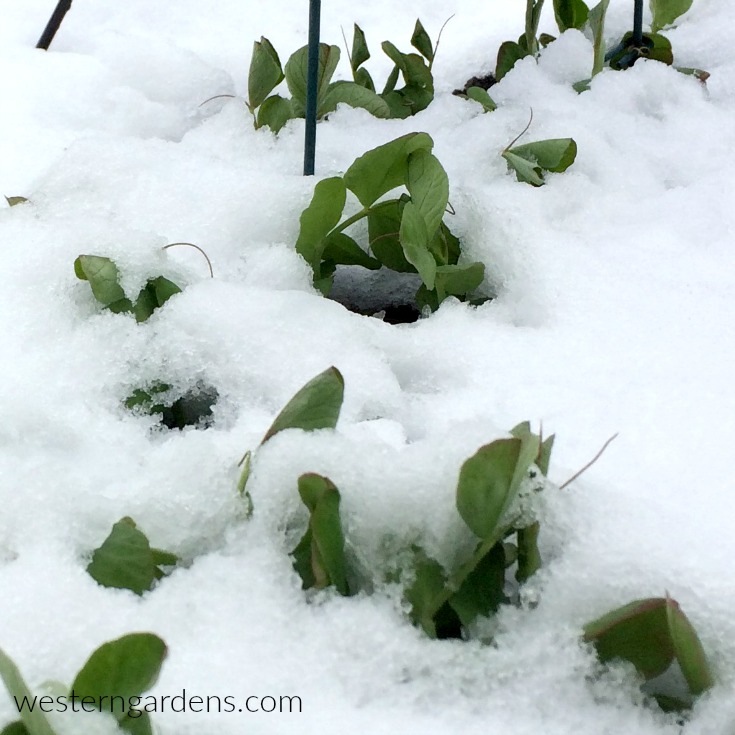
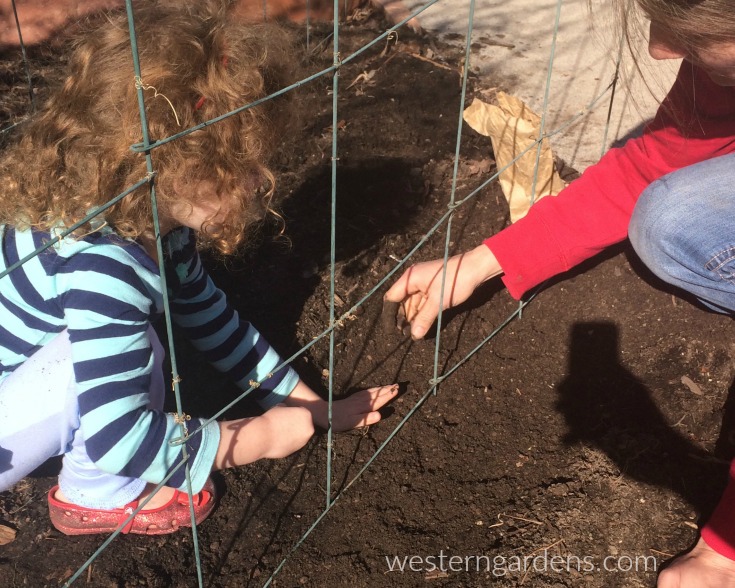
KIDS & PEAS … Planting peas is a great activity to do with young children.  The seeds are a real bonus to work with:

  1. They are large enough that they are easy for small fingers to pick up.  
  2. They are also easy to find after the inevitable spill.
  3. Planting is as simple as sticking your finger in to the ground, dropping in a seed, and covering with soil.  

Again, the size of the seed made this something I could do with my 18 month old.  She has helped plant every year since and even gets upset if she thinks she’s being left out of the planting process for the peas.
little girl planting peas with her mother

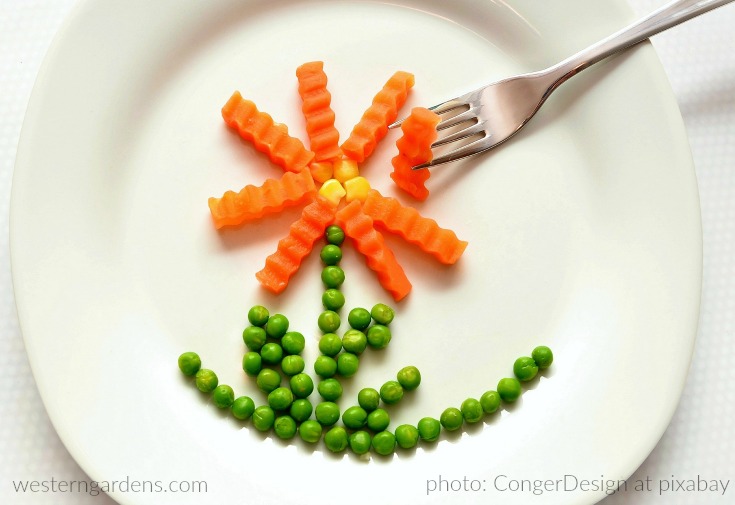
Peas and carrots on dinner plate - photo by CongerDesign - Pixabay CC0 license

Fun idea to see and eat the peas the children grow. That is if you can get any that far into the house from the garden!

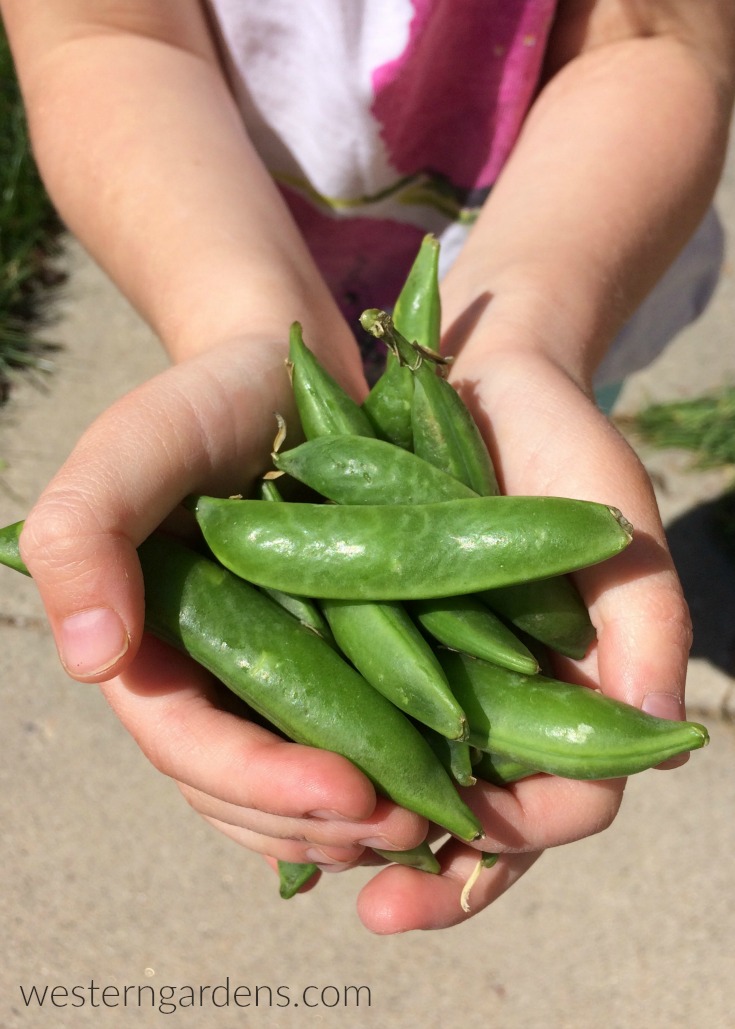
FRESH PEAS IN THE GARDEN… My husband will only eat shelled peas that are freshly picked from the garden.  If they’ve been cooked, frozen, canned, or otherwise tampered with, he will not touch them.  (He’ll eat snap peas in stir fry). When our daughter was very young, we’d go out in the garden to pick peas and she’d eat as many as we’d give her.  Her preferred method was eating them straight out of our hands. She will still eat as many as she can get her hands on, but she’s big enough to do the picking and shelling on her own now.  

plant peas to eat by the handful

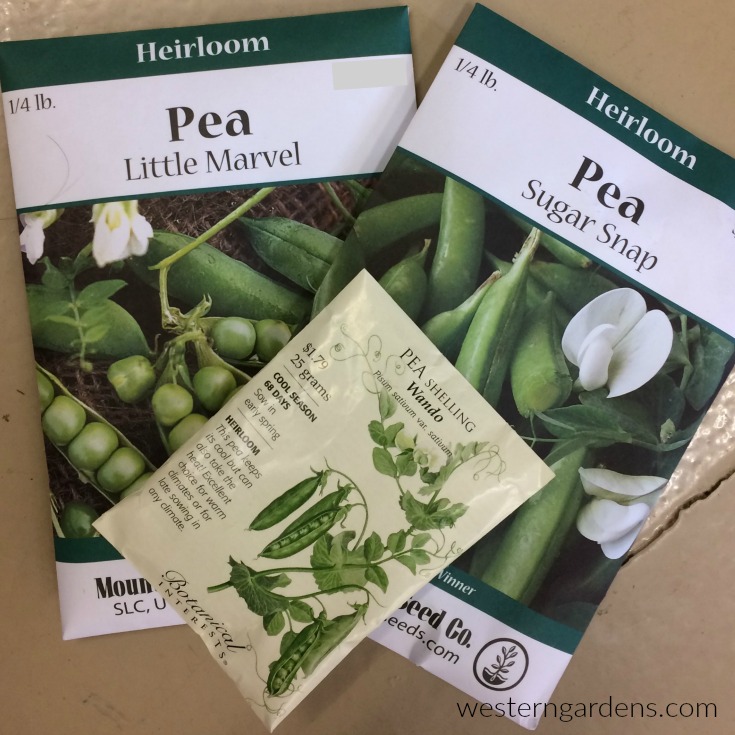
OUR FAVORITE VARIETIES…We’ve tried lots of varieties of peas over the past several years (Green Arrow, Alaska, Snap Peas, Little Marvel, Blue, and more) and have found that our favorites for flavor and abundance on the vine are Little Marvel (a shelling pea) and Snap Peas (edible pods, no shelling required).  We also grow Blue shelling peas because their flower is so beautiful. If you’ve never seen a blue pea, the flowers are purple and white and the pea pods are a dark purple/blue color, making them easy to find on the vine.  Buy quality seeds from your local garden center like Western Garden Centers in Salt Lake City and West Valley, Utah.

Find quality seeds of peas to plant at Western Garden Centers, garden shop in Utah

DID YOU KNOW… Peas are one of the oldest known vegetables.  Archaeologists have found them in ancient tombs at Troy and Thebes. Dried peas keep indefinitely.  This allowed them to survive the ocean voyage to become one of the first crops grown by English colonists coming to North America.

DID YOU KNOW… Peas are “nitrogen fixers”, meaning they take nitrogen from the atmosphere and convert it to ammonia (which is chemically comprised of nitrogen and hydrogen), thereby making the nitrogen available to other plants and organisms in the soil.  This means peas are a great spring crop because they naturally help fertilize your soil prior to planting other garden fruits and vegetables that need nitrogen in order to thrive (think tomatoes!).

TIP:  To maximize this benefit, at the end of the peas’ growing season, trim the plant off at the soil line instead of pulling them out, leaving the roots behind.

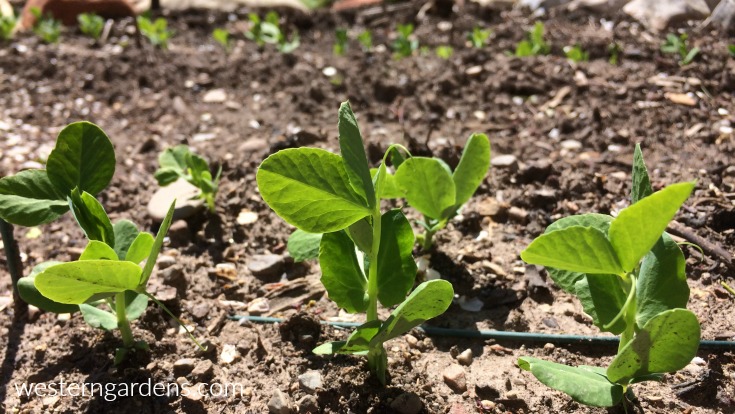
GROWING TIP … A friend suggested presoaking the peas prior to placing them in the soil.  This will soften the seeds and allow them to germinate more quickly. Soak for around 12 hours, no more than 24, before planting.  We tried it this year because we wish our peas would sprout sooner.  It worked!  Our peas were sprouted and broken through the soil less than 10 days after planting them, instead of 2 weeks or more.  We look forward to eating our peas that much sooner this year!  

Rows of planted peas coming up in the vegetable garden

FALL PLANTING … After the summer heat is gone (about Labor Day), plant peas again for a fall crop.  Read the package of which variety will produce according to the time you have.

Hmm…  Sounds like something new to try with our garden this fall.

Eat peas straight out of the garden


Filed Under: Gardening, Kids in the Garden, Tips & How To's, Utah Gardening, Vegetables, Veggie Gardening Tagged With: blue shell peas, cold hardy vegetables, cool season vegetables, garden peas, little marvel peas, peas, plant peas, snap peas, Utah gardening, zone 5 peas

Use Living Flowers for Centerpieces during Easter and Spring

April 14, 2017 by Jenn Crookston

Use living flowers for centerpieces this Easter. Contains basket, tulips, bunnies, fake grass and plastic eggsIt’s pretty safe to say the very best part of Spring is the beautiful living flowers for centerpieces.  I love having fresh flowers in and around my home.  I love the instant brightness they bring and the amazing smells…it’s like bringing sunshine right inside the house.
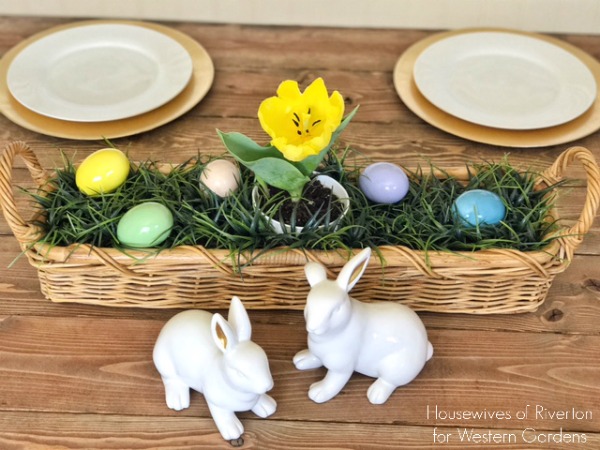
As I plan my spring and Easter decor I love to plan for flowers anywhere and everywhere I can.  While I love a beautiful spring bouquet I especially love finding ways to use fresh flowers inside that I can then transfer outside so they can continue to grow and beautify my home.
Easter table centerpieces with tulips and ceramic bunniesFirst up I have this adorable Easter Table Centerpiece.  Using just a few items (many you may already have on hand) you can create the perfect centerpiece for your Easter dinner that will last for years to come because you can take that Tulip bulb and plant it in your yard!

Easter Table Centerpiece Supplies:
Basket
(I used a long skinny one I had on hand, you could use any variety)
Fake Grass
(or real grass if you plan ahead and grow some – see growing Wheatgrass)
Small Bucket
Fake Eggs
Ceramic Bunnies
Live Flowers
(I used a tulip, but again any flower would work.  Dainty primroses and colorful pansies are also great living flowers in centerpieces.)

First gather your supplies, plant your flower in the bucket and then place the bucket in the center of the basket and arrange your fake grass.  Once you have the grass arranged place fake eggs in the grass, mine had a hole in one end so I made sure to place the egg so that wouldn’t show.

I used two ceramic bunnies in front of the basket to bring the whole Easter look together. Simple and oh so cute.
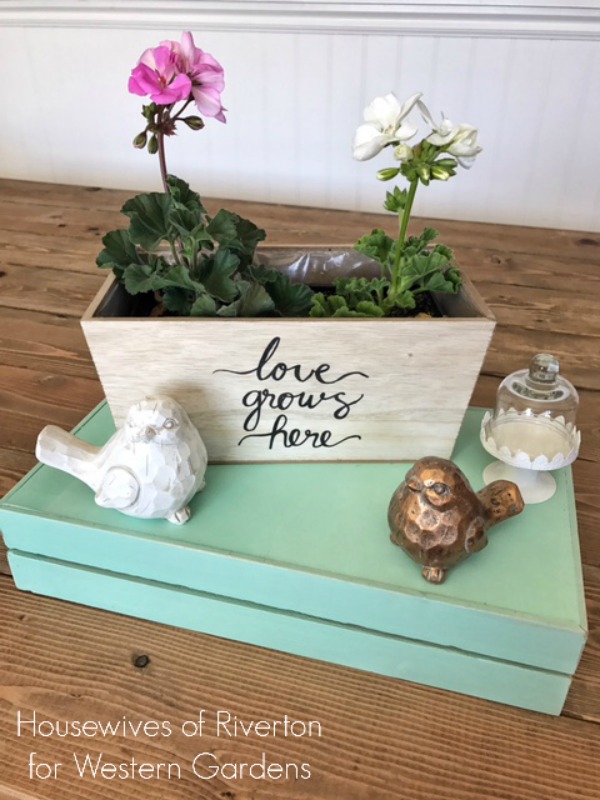
Geraniums are a great way to use living flowers for centerpieces.
Once bunnies and Easter eggs are past being in season it’s time for a new Spring Centerpiece to take over the table.

Spring Table Centerpiece Set Up:
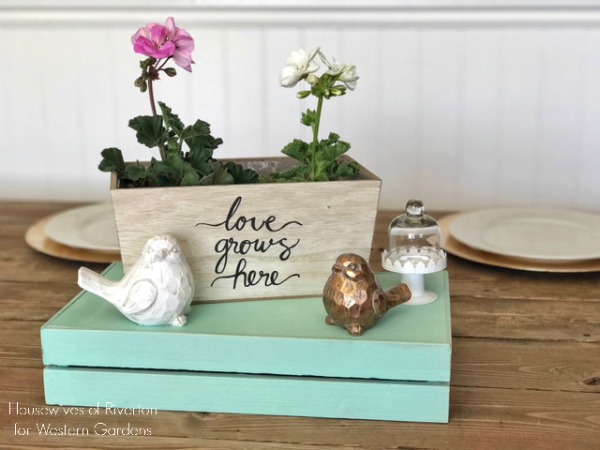
I found this cute blue crate at Target and flipped it upside down then added these little chubby birds and tiny cake stand from Hobby Lobby.  The Love Grows Here crate is also from Target and I love that it comes lined with plastic so adding flowers that need watering won’t damage it or anything under it.

I added two geraniums in their little plastic store bought containers, they are a perfect fit!
Easter table centerpieces with geraniums
While I love love love how both of these centerpieces turned out I think my very favorite part is that when I’m ready to make a change for the next season/holiday I get to plant these flowers outside and watch them continue to grow, I don’t have to throw them away in 7-10 days like we have to with cut flowers.

I highly recommend finding ways to bring living flowers into your decor.  I promise they’ll put a smile on your face every time you walk past them.

Filed Under: Crafts, Flowers, How To, Tips & How To's Tagged With: DIY, easter centerpieces, flowers, home decor, living flowers, living flowers centerpieces, spring centerpieces, use living flowers in centerpieces, Western Gardens

  • « Go to Previous Page
  • Go to page 1
  • Go to page 2
  • Go to page 3
  • Go to page 4
  • Go to page 5
  • Go to Next Page »

Primary Sidebar

Shopping Cart

Items in Your Cart

Your cart is empty
Visit The Shop

Follow Western Gardens

  • Facebook
  • Instagram
  • Pinterest
  • YouTube

See what we’ve been pinning!

Follow Me on Pinterest
Followed by people.
?

Pinterest Badge by Skipser

Here’s What We’ve Been Up To!

Save water and money by Turf Training - train your lawn to grow deep roots
work at western gardens utah garden center
Senior gardening woman Edu Carvalho from Pexels
A Utah Guide to Vertical Gardening in square shape

Copyright © 2026. Western Gardens - Privacy Policy