• Skip to primary navigation
  • Skip to main content
  • Skip to primary sidebar

Western Garden Centers

for what grows here

  • Home
  • How To
  • Gift Cards
  • Calculate Mulch
  • Locations
    • Store Hours
    • About
    • Garden Shop Employment Team
  • Weddings
    • Salt Lake City, UT
    • West Valley, UT
  • Blog
    • Gardening
    • Recipes

how to's

May Gardening To-Do List

May 2, 2017 by Western Gardens

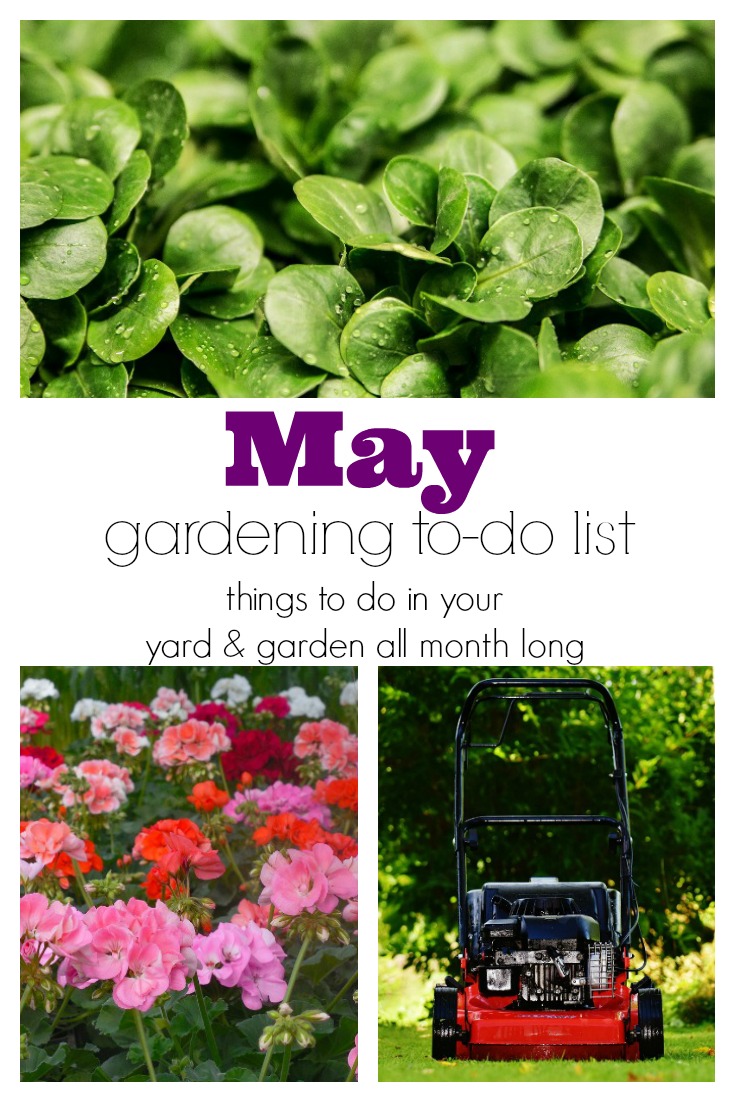
May Gardening To-Do List for all the things you don't want to forget (but don't have time to remember!)

Hello Gardening Friends, thanks for stopping by!

If you’re excited to work in your yard or garden, but not sure where to begin, then you’ve come to the right place!  We’ve put together a list of things to do throughout the month.
May Gardening To-Do List for all the things you don't want to forget (but don't have time to remember!)

You may not need to do everything on this list.  For example, if you don’t have bare patches to reseed or Spring bulb foliage to cut back, skip over those items on the list.  Just pick what applies to your home and yard and plan out when you will do it all throughout the month!
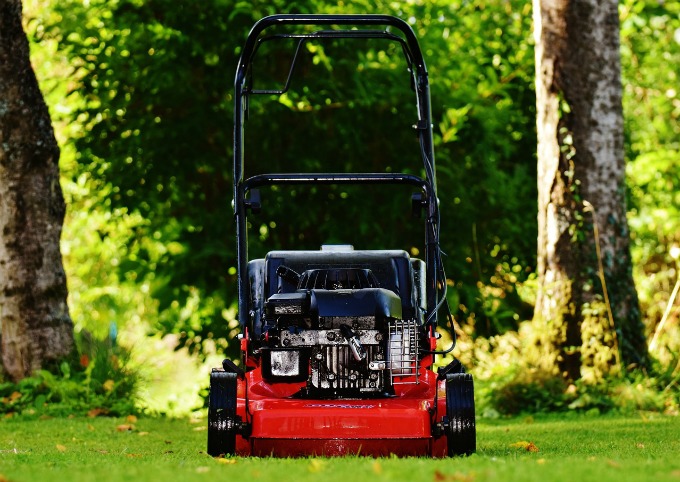
May Gardening To-Do List for all the things you don't want to forget (but don't have time to remember!)

May Gardening To-Do List

➺Train your Lawn – Turn Sprinklers On only when needed – Let the lawn tell you when it needs watering. Click here for more details.

➺Lawn Watering – Use a “moisture meter” probe to determine adequate moisture.

➺Water Conservation – Conserve water by watering before 10:00 am or after 6:00 pm.

➺Lawn Aeration – Its not too late if you haven’t already.

➺Set Lawnmower Height to 2½-3 inches. This allows the lawn to “shade” its soil making for a healthier lawn.

➺Lawn Broadleaf Weed Control (Liquid application) – for Dandelions, violets, etc. Weed-A-Lawn is a great product.  Spot treat or apply to big areas of lawn where needed. Follow manufacturer’s instructions.

➺Lawn Crabgrass and Spurge – Second application of pre-emergent granular (6 weeks after the first application).

➺Fertilize Lawn with a weed-killing post-emergent granular fertilizer —do NOT water in—apply it to a moist lawn and let it sit for a day

➺Seed Bare Patches in Your Lawn unless you’ve already used a pre-emergent, in which case, wait until September to seed bare patches.  Click here for more.

➺Weed, Thin Out & Mulch newly planted seedlings

➺Plant Your Favorite Annuals for beautiful color—most can be safely planted after frost danger has passed (some are hardy enough to be planted earlier, check with your local nursery)

➺Spring Bulbs – Remove Spent Flower Heads (aka dead-heading) and AFTER foliage fades and turns brown, cut back leaves.

➺Summer Blooming Bulbs – Plant dahlias, day lilies, and gladiolus.  Click here for instructions.

➺Plant Trees, Shrubs, and Perennials – Early spring or late fall are great times to do this.  Click here for tips.

➺Divide and/or Transplant Perennials – Summer bloomers: early in the month.  Spring bloomers: after blooming is done.

➺Flowering Shrubs  – Prune after they finish blooming.

➺Pest Control – Boxelder bugs are a nuisance.  Grasshoppers are best controlled when they first hatch.  Watch for Leaf roller on boxelder trees. Try to stay ahead of those slimy slugs and snails.  Closely follow directions on labels when using insecticides as not to harm bees.

➺Plant Outside
Kohlrabi, parsley, parsnips, potatoes,
Until May 15th: onions & peas
After last frost until June 1st: dry beans, snap beans, eggplant, peppers
After last frost until June 10th: watermelon & winter squash
Until July 1st: cauliflower, parsley, swiss chard
Until July 15th: beets & broccoli
After last frost until July 20th: cucumbers and summer squash
Until Sept 1st: radishes

and so much more….

If you liked learning these tips from the experts, here is another good tip – come in and visit us!

Be sure to check out our June Gardening To-Do List too!

*This is not an exhaustive list.  If we’ve overlooked something, feel free to let us know in a comment below!
May Gardening To-Do List for all the things you don't want to forget (but don't have time to remember!)

Filed Under: Gardening, How To, Lawn Care, To-Do List, Utah Gardening, Yard Care Tagged With: Gardening, how to's, may gardening, Monthly To-Do List

Wheat Grass Easter Eggs – Kids Project

March 28, 2017 by Wendy Pettit

Welcome Friends!  Glad you dropped in.

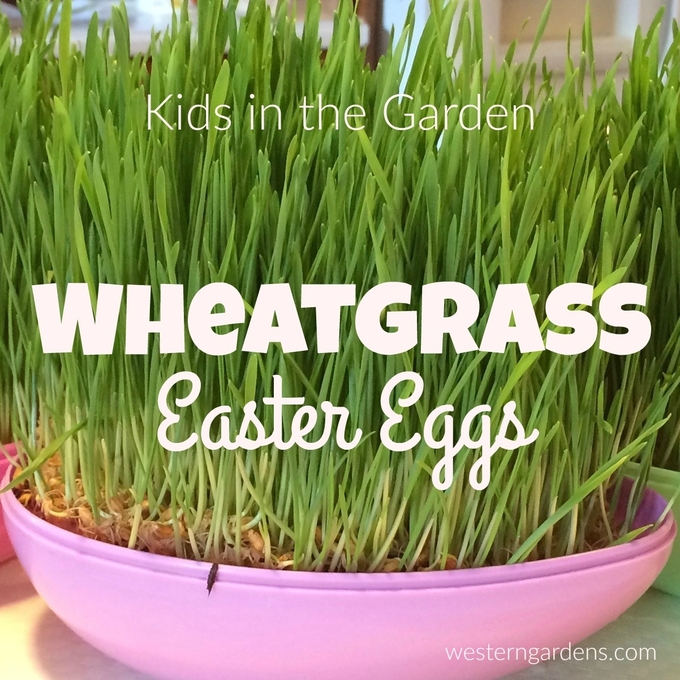
This Wheatgrass Easter Egg is a great kid craft to do anytime in the spring, not just for Easter.  It is inexpensive and easy to make – even little 3 year-old hands can do this; customizable to whatever you have – plastic egg, bucket, basket, whatever; quick and fun to do – who doesn’t like to play in the dirt; and very gratifying within a few days – children observe the growing seeds.  If you want to do this for the holiday, you need to think ahead about 1 1/2 weeks. Easter changes every year, so be sure to check the calendar!

wheatgrass easter eggs are simple to make and fun to watch grow.

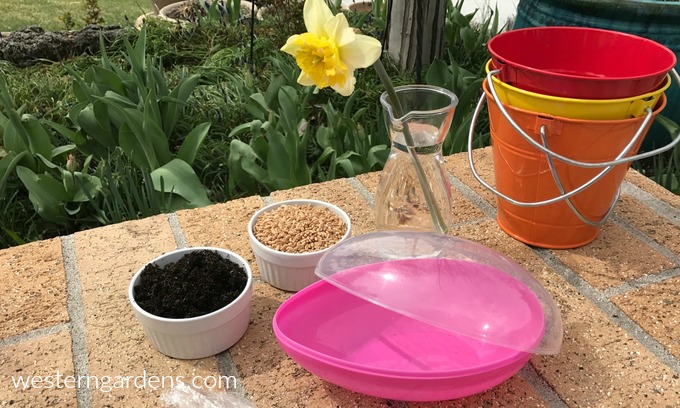
SUPPLIES:

» Leak-proof Easter container – pail, bottle, cup, plastic-lined basket, etc.  (I’m using a large plastic easter egg I found at my local dollar store. It came with a lid.)

» Plastic wrap or plastic lid

» Potting soil or vermiculite  (I used potting soil from my last year garden pots.)

» Whole-wheat grain (I used 30 year old wheat I had in my food storage.)

» Water

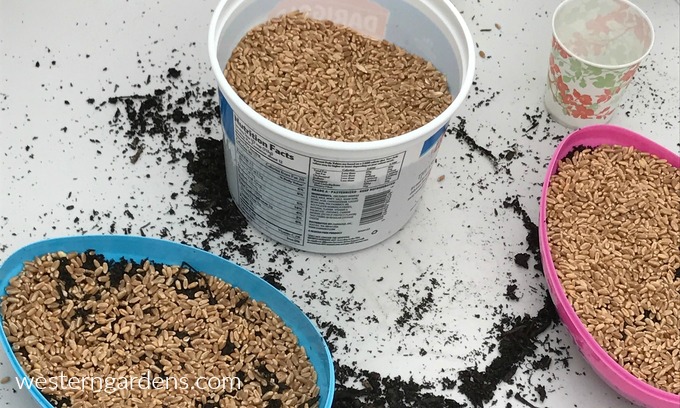
Items needs for making wheatgrass easter egg project.

Soil, whole wheat grain, container, plastic wrap or cover, and water. That’s it!

Wheatgrass Easter Egg INSTRUCTIONS:

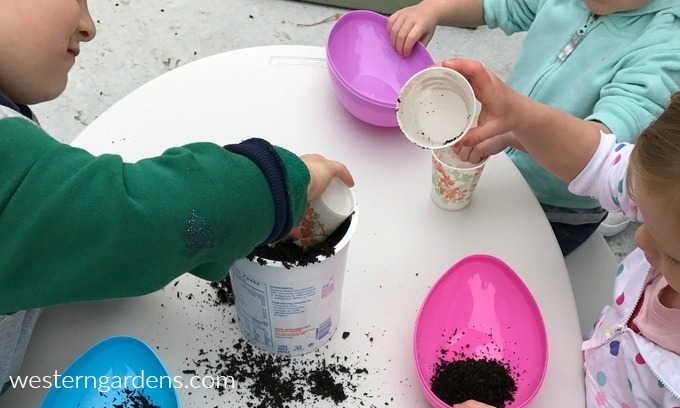
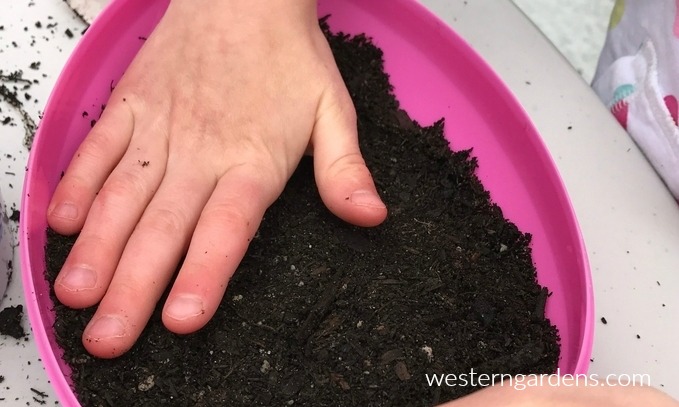
1. One to two weeks before Easter, fill container with soil or vermiculite to 1-2 inches below the top of the rim.  Gently pat down.

Placing soil into container.

Little by little putting soil in to within 1-2 inches of rim.

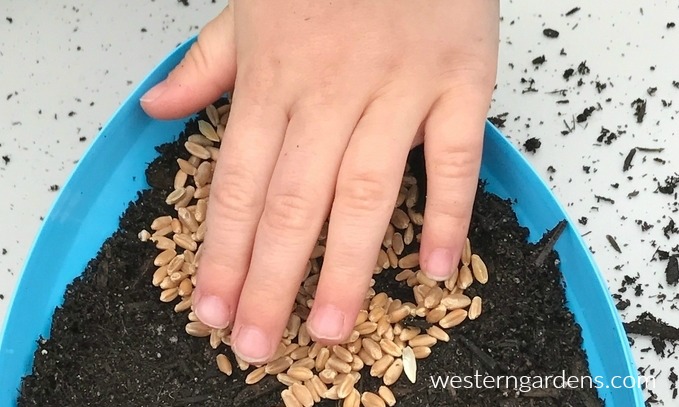
Pat down the soil

Gently pat soil. (You can talk or sing to it too if you want!)

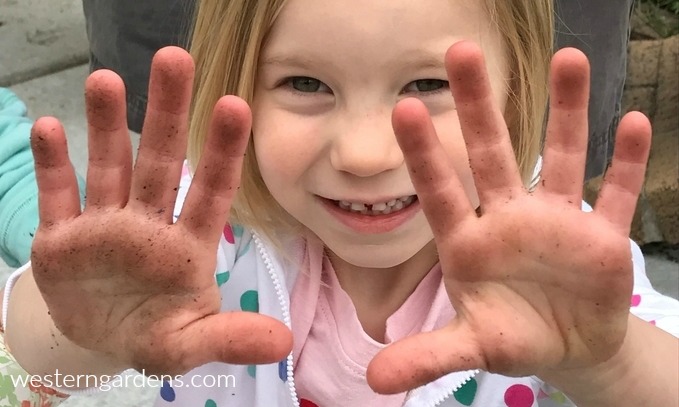
Little girl with soil on hands.

Don’t have to get all dirty!

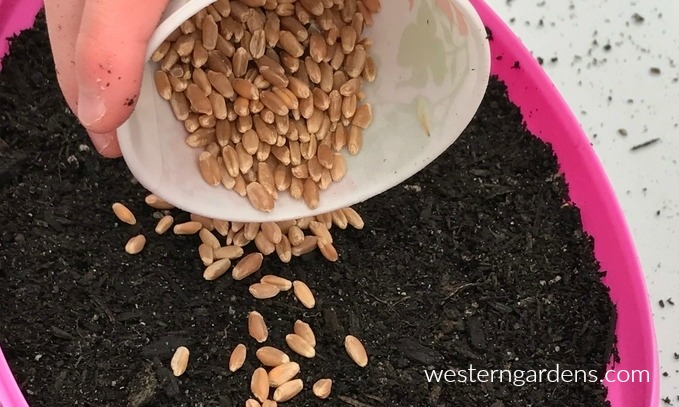
2. Sprinkle a layer of wheat over the soil.

Sprinkling wheat grain on top of the soil.

The layer of wheat stays on top of the soil. Do not cover the seeds with dirt.

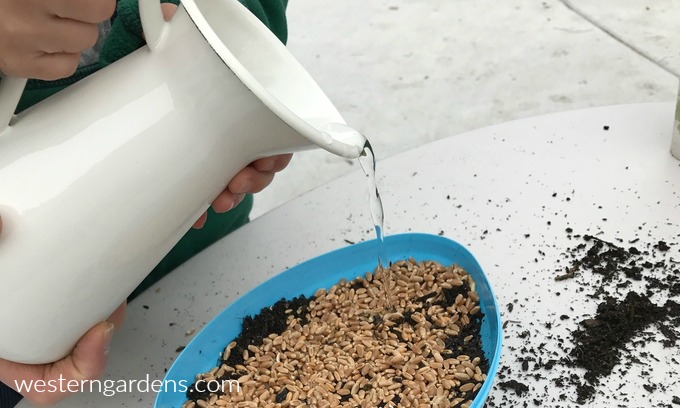
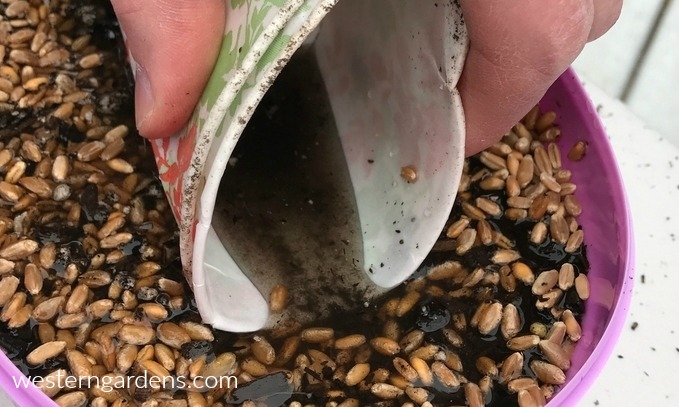
3. Pour water into container until water is barely visible beneath the wheat.  Note: Drain or “bail” out some water if you accidentally add too much and the seeds are swimming.

Pour water onto seeds and dirt.

Be slow and careful when pouring water into your container.

bailing out too much water from seeds and soil.

Be careful to bail out water if you get too much. Don’t want the seeds to drown!

4. Place lid or plastic wrap over the wheat.  

5. Place container in a sunny spot (not in direct sunlight).

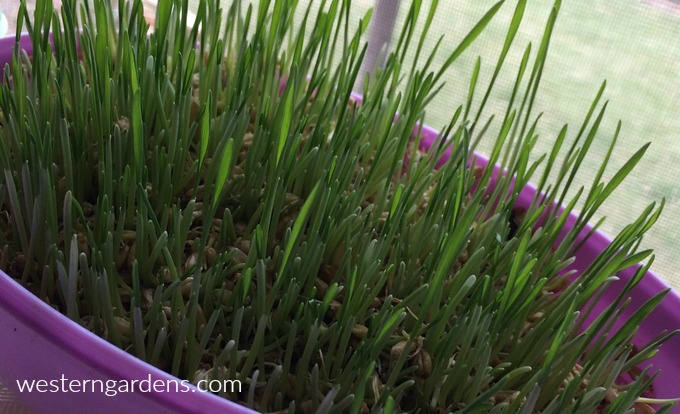
6. After 2-3 days, small sprouts should appear.  Remove plastic top.  

Little wheatgrass starts are popping out.

Take lid or plastic off when you see the wheat growing. Put in good sunlight (not direct-sunlight).

7. Watch your wheatgrass grow.

NOTE:  During this process, if wheat appears to be dry, mist lightly with water.

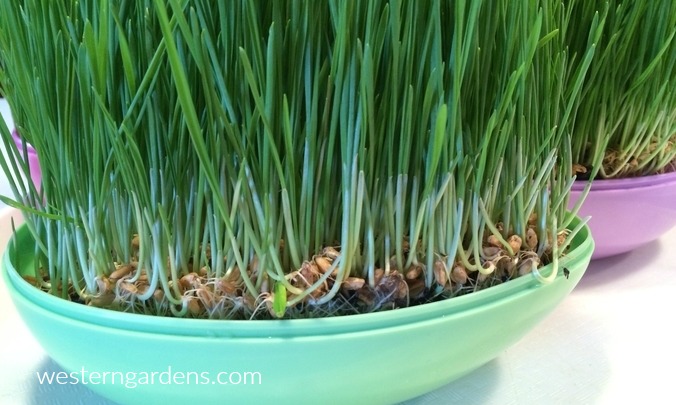
8. In 7-10 days, you should have a velvety grass patch!!  

wheatgrass grows quickly.

Be patient and watch your grass grow. For fun, get a ruler and mark how far the grass grows in a day.

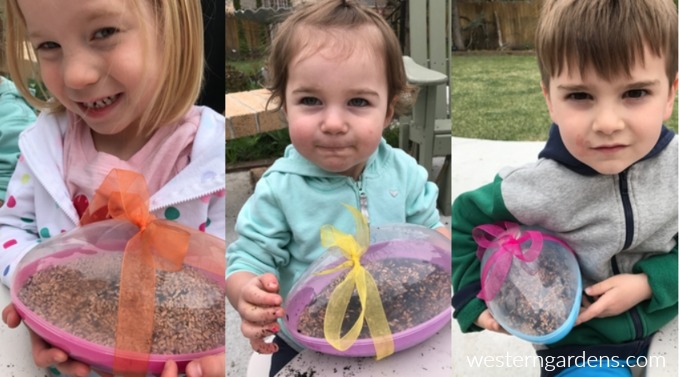
I initially did this project with a group of women.  We tied pretty ribbons around the eggs and shared them with family and neighbors to watch grow.

Wheatgrass Easter Eggs are ready to give away with ribbon around them.

Put a ribbon around the egg and give to another to let them see the seeds grow. Or keep for yourself and enjoy measuring how much the grass grows in a day! Or make a fairy garden in the grass!

9. Add smaller plastic eggs or other little Easter characters in the wheatgrass, if desired.  After the wheatgrass had grown in the egg that I kept for my own family,  I placed in the grass colorful plastic eggs filled with jelly beans and other Easter favorites.  IDEA: It could be fun to create a fairy scene.

A byproduct of this activity – Wheatgrass juice  

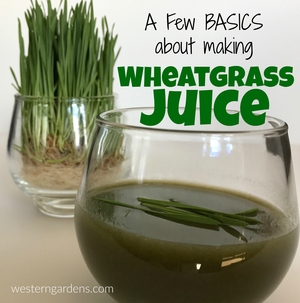
Instead of throwing away your Wheatgrass Easter Egg, you could try making wheatgrass juice.  You’ve got a good little crop to give it a try.  Wheatgrass is gluten-free and is touted as one of the best super foods.  Many believe that it can detoxify the body and improve digestion.   Learn some basics about preparing this superfood by clicking here. 

Basics about wheatgrass juice


Filed Under: Crafts, How To Tagged With: Easter, easter craft, easter eggs, how to's, kid crafts, kid friendly, Kids Craft, seeds, wheat, wheatgrass

Snow Mold on Your Lawn – 8 Simple Ways to Solve

March 11, 2017 by Wendy Pettit

Welcome Gardening Friends! Thanks for stopping by.

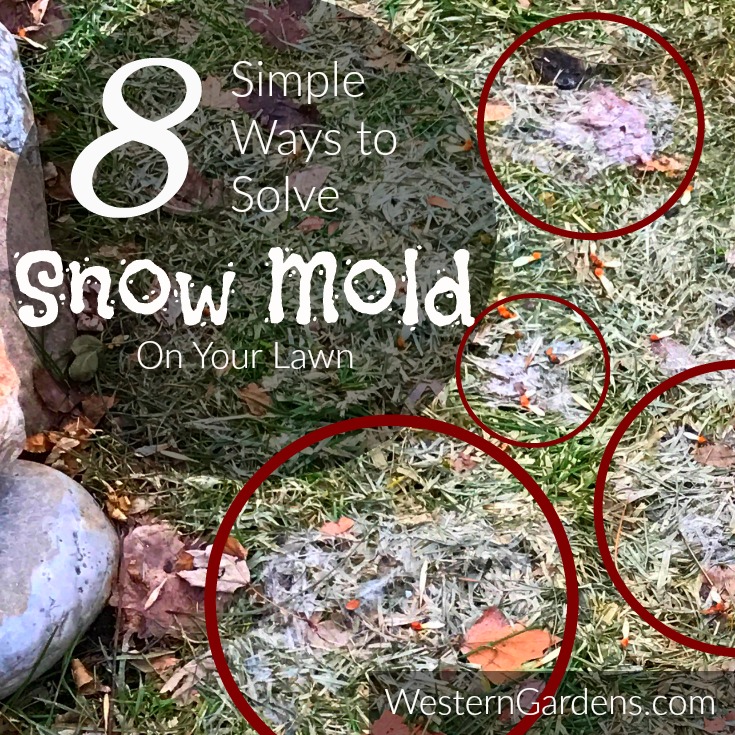
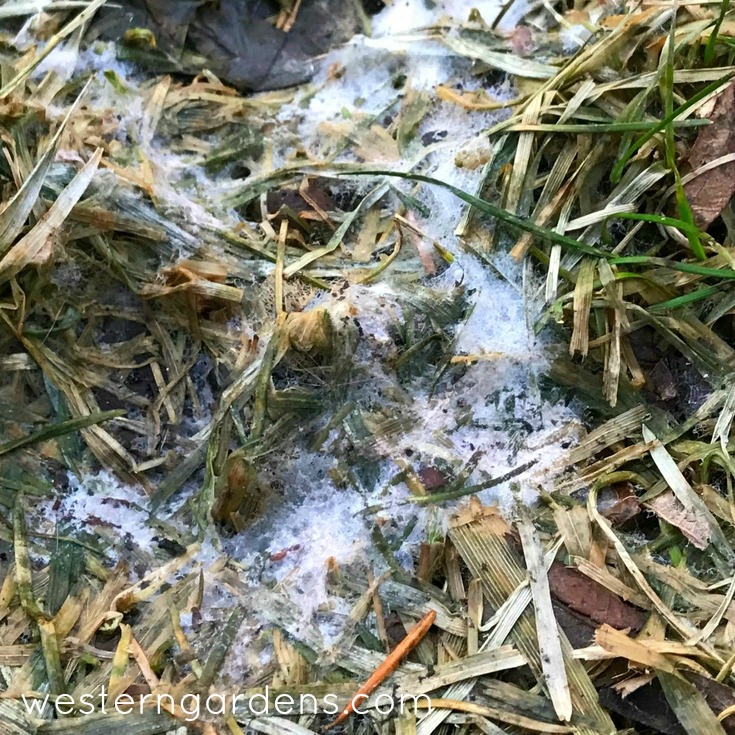
When the snow finally melted off our back lawn, my grass looked like it was dying. If yours does too, it could be a lawn fungus called SNOW MOLD. Don’t worry too much, snow mold seldom destroys the lawn; your lawn will recover.  This annoying disease can appear when the snow melts off the lawn in the spring.  Your turf will have circular type patches of matted straw-colored grass and can have a top layer of stringy mold.  (It reminded me of a salad mold that once grew in my refrigerator.) 

Here are 8 simple ways to solve SNOW MOLD on your lawn, and better yet, prevent it from happening.

8 ways solve snow mold on lawn

Current Problem Solutions to Snow Mold –

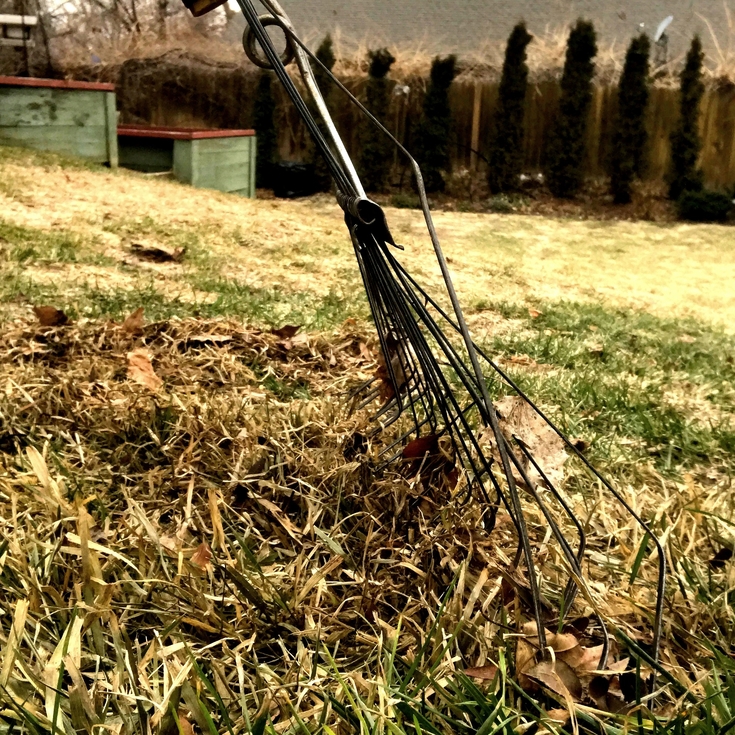
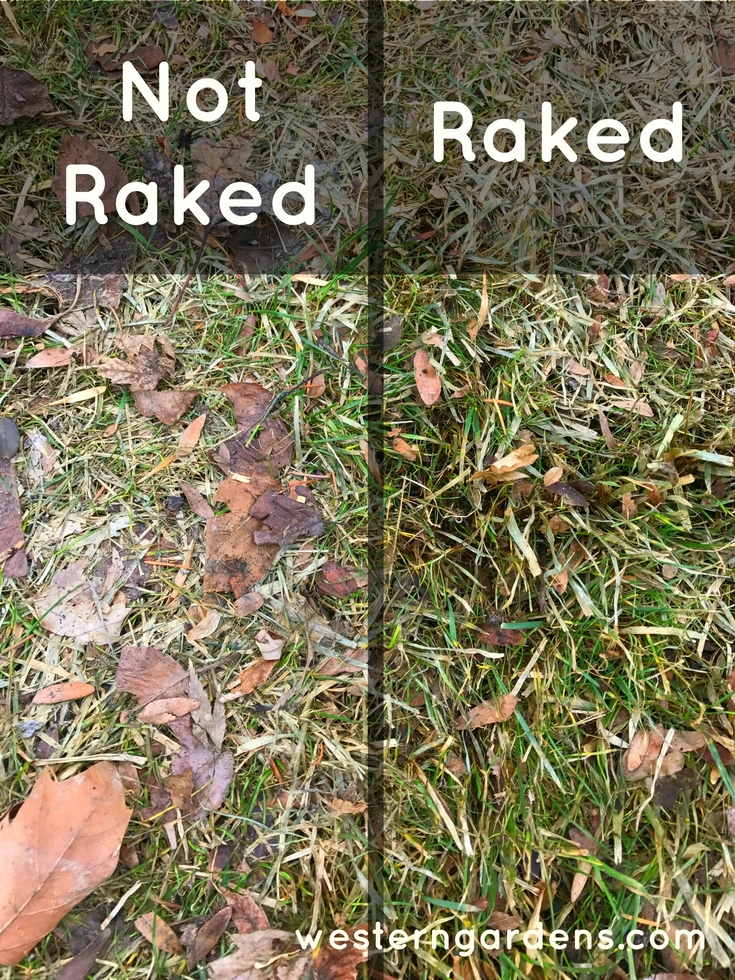
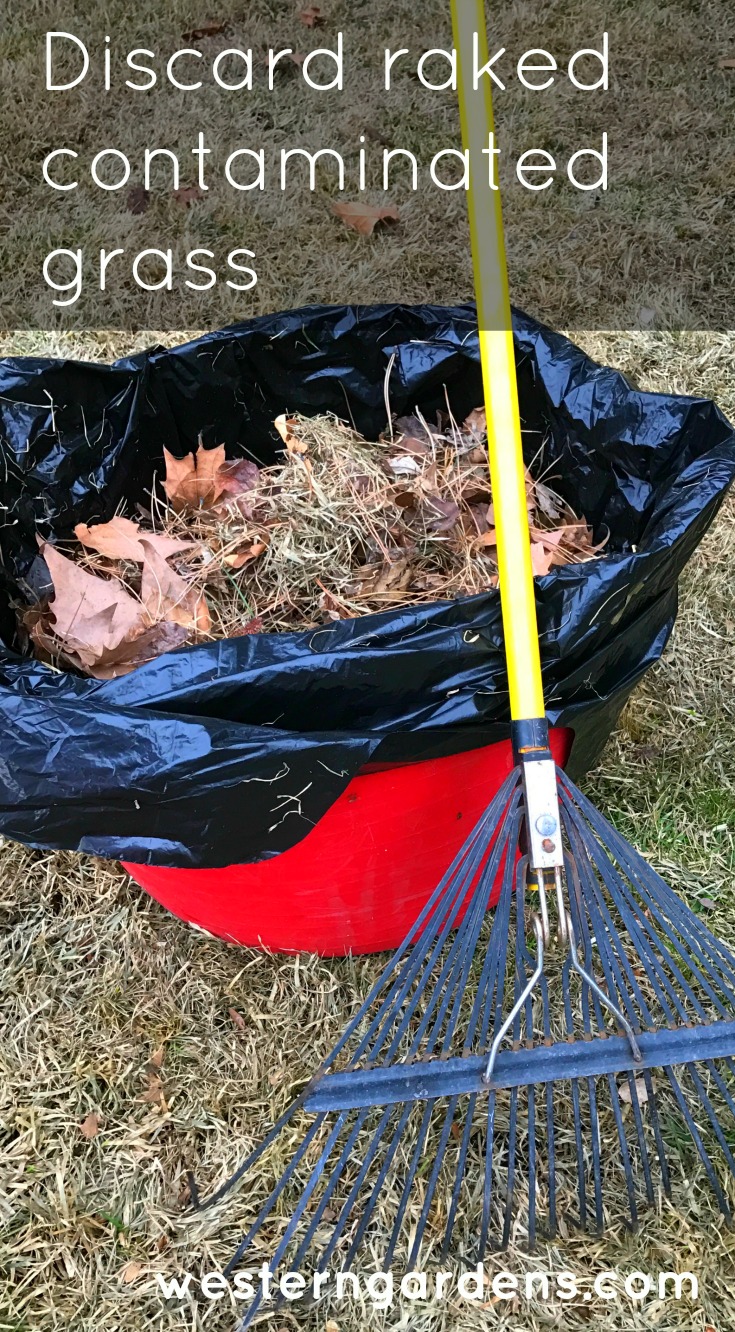
  • In the spring when you discover the mold, take action by gently raking the area.  This will help the air circulate through the lawn to dry it out and stop the mold from growing further.  Be careful not to rip up the grass.  The disease usually affects only the blade, so the crown of the plant is still good and will recover.  Throw away the grass you have raked up.rake grass to stop snow mold from growingbefore-and-after photos of raked lawn for snow mold
  • According to the proper schedule, regular fertilizing and mowing will help your lawn outgrow the fungus.  The lawn will green up and the damaged blades will eventually be cut off.
  • If your lawn has extreme snow mold, and you have tried the above solutions, a disease control product may need to be applied to the affected area.  See your local garden center, like the experts at Western Gardens, to obtain the correct product.  It’s always a good idea to take to the garden shop samples of the diseased plant and a photo of the area.

discard snow mold contaminated grass

Snow Mold Preventative Actions –

  • In the fall, be sure to rake leaves off the lawn. This can be annoying if you have trees that take all winter to lose their leaves, like a Sycamore.
  • In the fall, be careful not to use excessive nitrogen fertilizer. This will help slow down the growth of the grass before winter arrives.
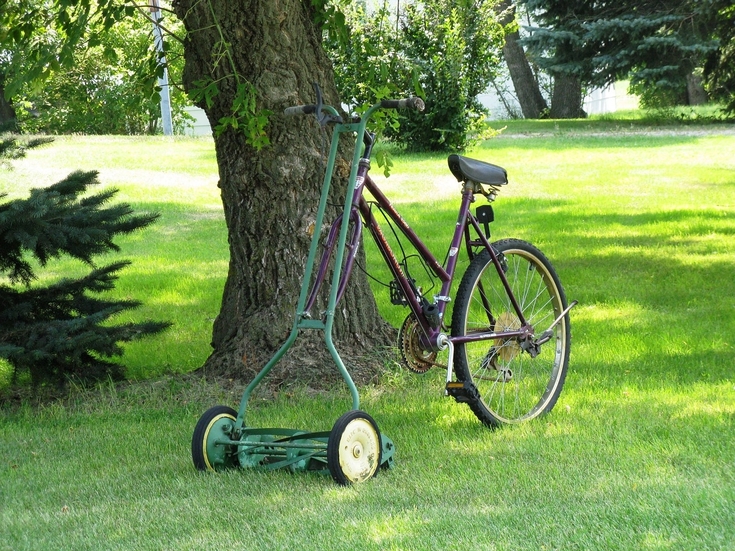
  • In the fall, be sure to continue mowing until the lawn’s growth slows down.  Make sure your last mowing is a shorter cut.  The taller the blades of grass when winter hits, the more snow mold is encouraged to develop.  (I believe this was the culprit for our problems this spring. We put the lawnmower away and then had a mild fall.)bicycle lawn mower
  • If each year you have this problem in certain areas, apply a fungicide to the grass in the fall.  Be sure to talk with your local garden expert for the correct preventative product.
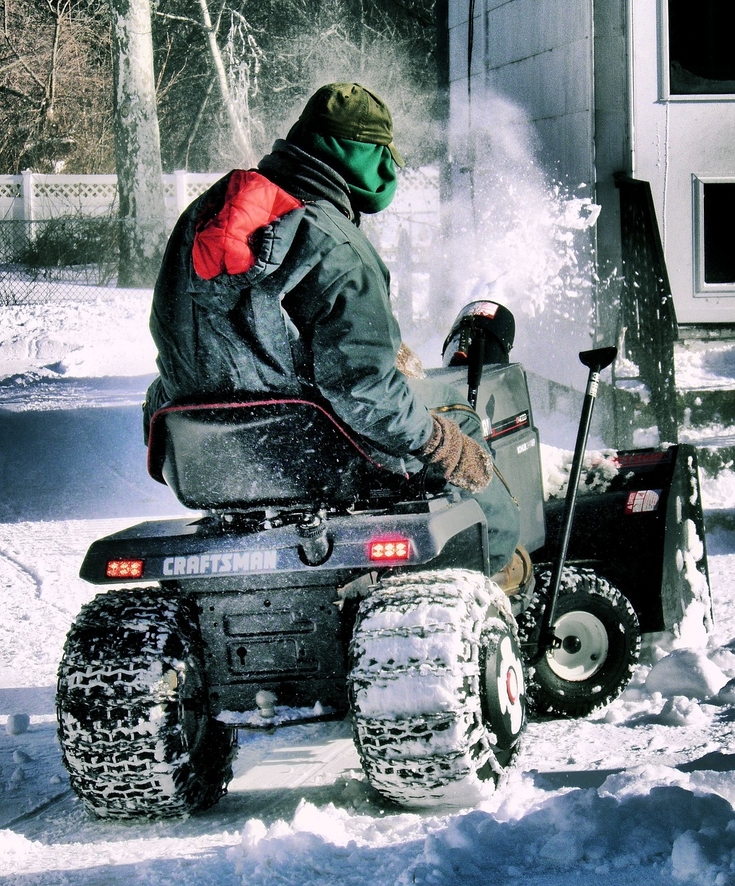
  • In the winter, if piles of snow build up where you or the street plows have worked, be sure to disperse the snow.  Where the snow is too deep on your lawn, it can take much longer in the spring to melt, inviting snow mold to grow with the warm spring temperatures. riding snow plow in cold winter
snow mold close up on lawn

SNOW MOLD on my Utah lawn

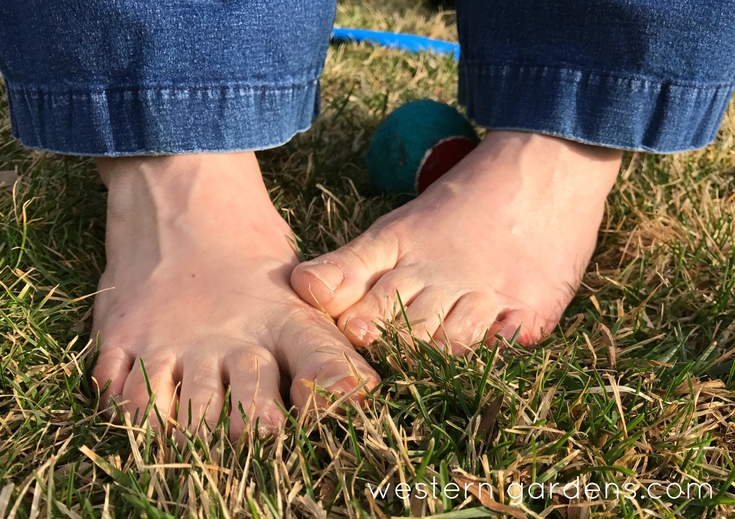
This warm weather signals time to dig in the dirt; but first, I’m going to walk barefoot through my recently raked and drying lawn.

barefoot in grass

Filed Under: Gardening, Lawn Care, Tips & How To's, Yard Care Tagged With: fall lawn care, how to's, Lawn Care, lawn disease, lawn fungus, snow mold, spring lawn care

DIY Tabletop Terra Cotta Fire Pit

June 7, 2016 by Sydney Anderson

Hi there, thanks for stopping by today!

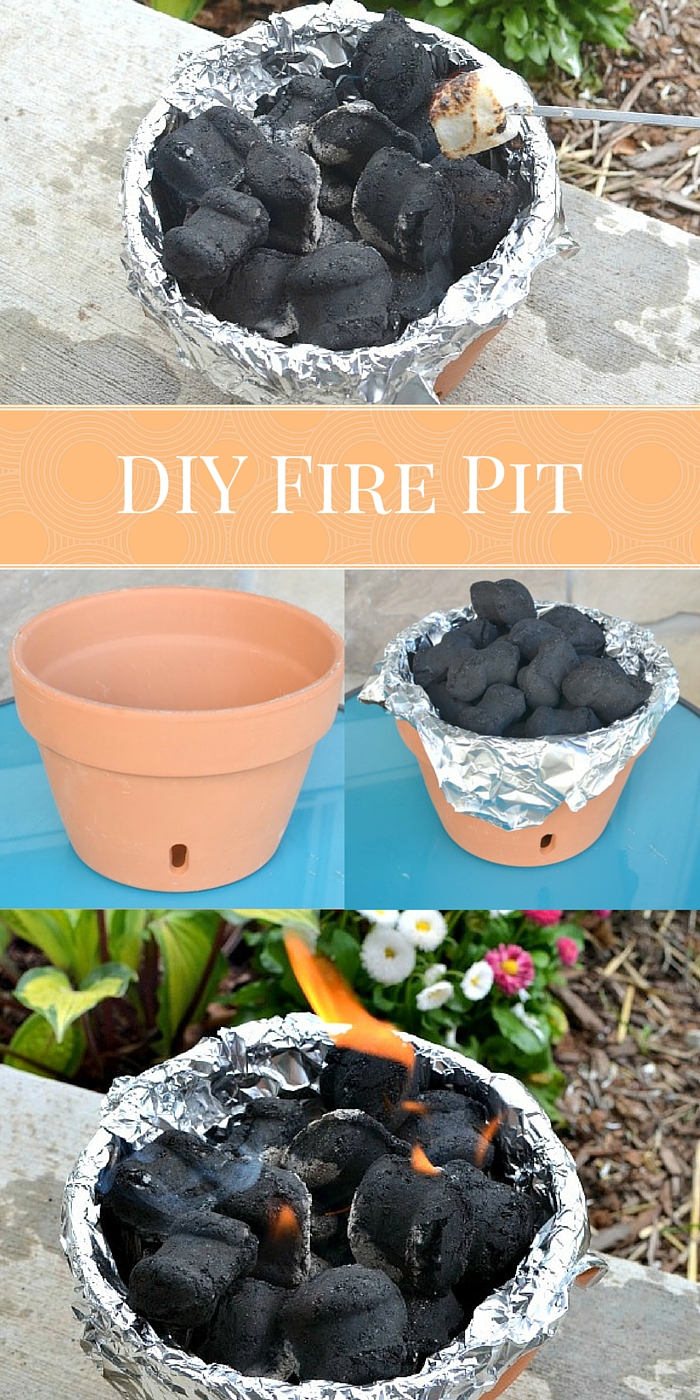
DIY Fire Pit: Make Your Own Campfire At Home For Less Than $5 | Western Gardens

Do you love camping with your family in the summer?  Roasting hot dogs and marshmallows over a fire with the people you enjoy most?  Me too!

Some of my favorite memories are of camping in the mountains, at the lake, in the desert, and even in the backyard!  I can’t wait to make the same memories with my boys…but since I’m 20+ weeks pregnant, sleeping on the ground isn’t very appealing.
DIY Fire Pit: Make Your Own Campfire At Home For Less Than $5 | Western Gardens

So we’re bringing my favorite part of camping right to our front porch—campfires!

There’s nothing better than sitting around a camp fire, roasting hot dogs, making s’mores and just spending time together, laughing and telling stories. Currently we live in a great little townhome community— without a backyard—so building a fire pit was out of the question.

I couldn’t let that stop me!

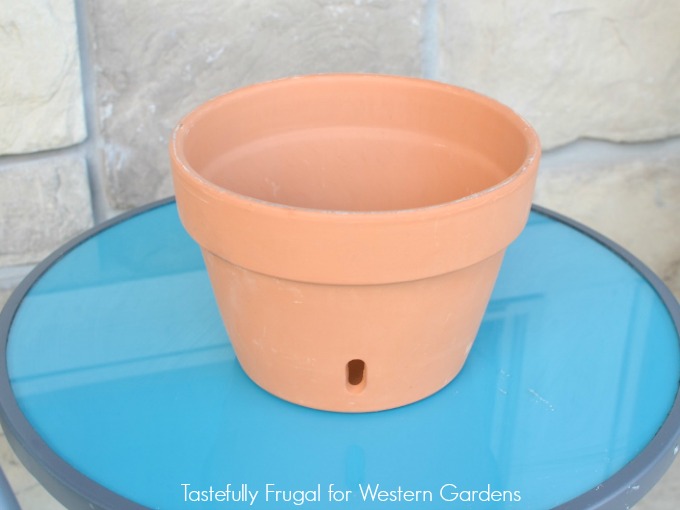
DIY Fire Pit: Make Your Own Campfire At Home For Less Than $5 | Western GardensI took matters into my own hands and made a mini fire pit out of a terra cotta pot for our front porch!  I took my husband, who is definitely the brains of our family, into Western Gardens and he picked out this terra cotta pot with holes in the bottom.  The holes allow more oxygen to enter the pot (just like on a charcoal grill), which will let the fire burn longer.

Longer lasting fires are perfect for those summer nights when the kids are playing, grown ups are chatting and you want to be able to make more s’mores when you get that craving (which happens a lot when you’re pregnant!).

Click NEXT to get the simple instructions!

Western Gardens | Utah

Pages: Page 1 Page 2 Page 3

Filed Under: Crafts, Outdoors Tagged With: DIY, Fire Pit, How To, how to's, Terra Cotta Pot, tips, Utah, Western Garden Centers, Western Gardens

Mother’s Day Flower Garden in a Basket

April 30, 2016 by Jenn Crookston

Welcome!  I’m so glad you’re here.

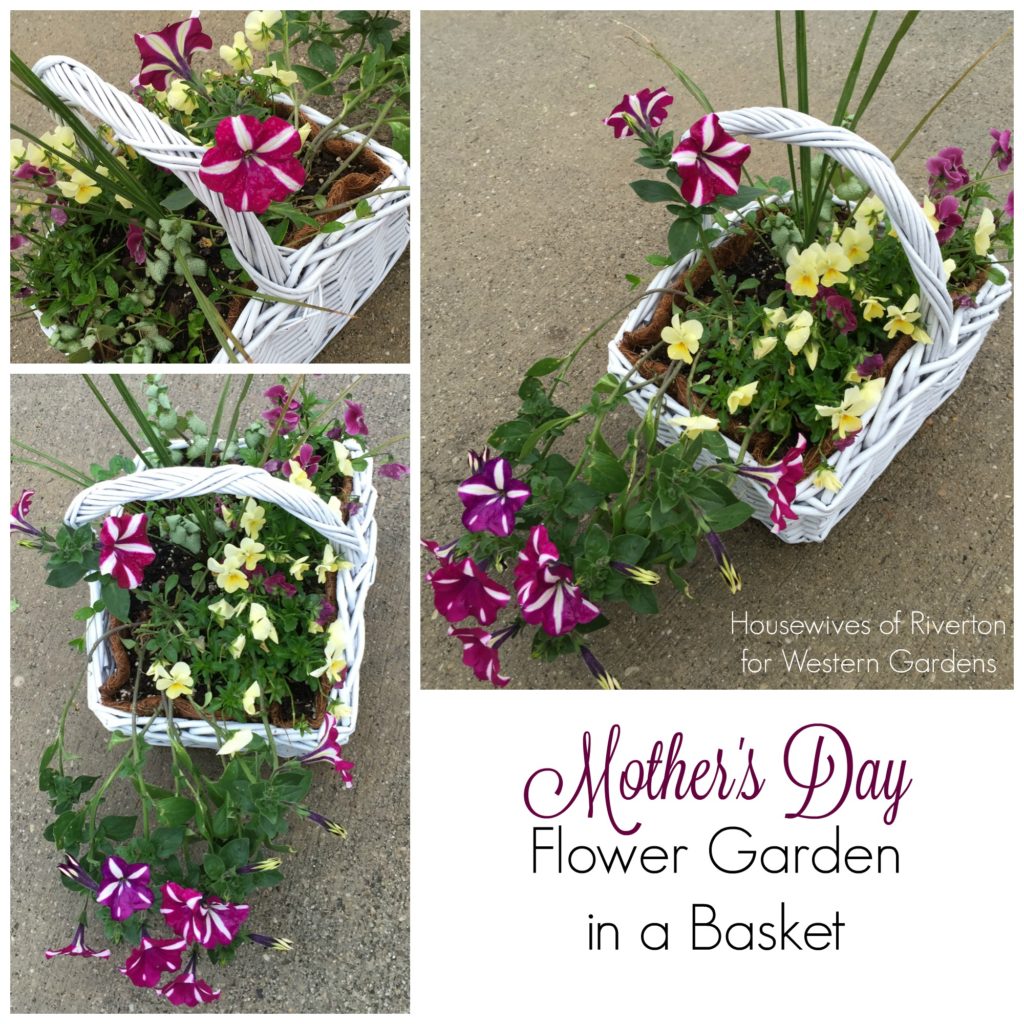
Mother's Day flower garden in a basket

Do you love gardening and giving beautiful gifts?  Then I have the perfect project for you!

I’ve been bitten by the gardening bug this year.  I have been enjoying getting my hands dirty and creating beautiful things with flowers.  This Mother’s Day Flower Garden in a Basket quickly turned into a favorite project!
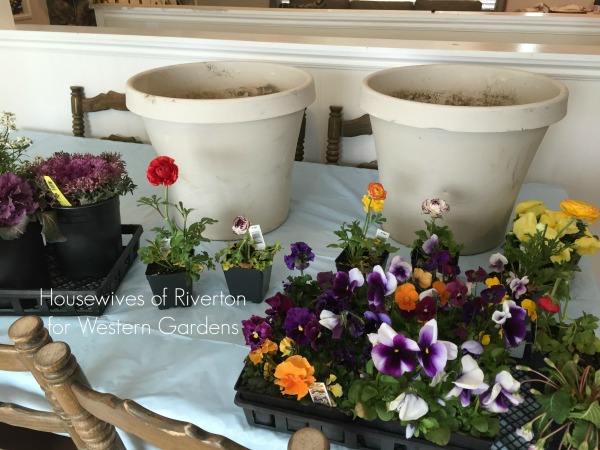
Looking for a simple but beautiful gift for Mom? Try this Mother's Day Flower Garden in a Basket!

I love when an idea turns out how I hoped it would when I imagined it.  What I love about this project is that it is easy to customize, it can be as big or small as you want and can include a variety of flowers.

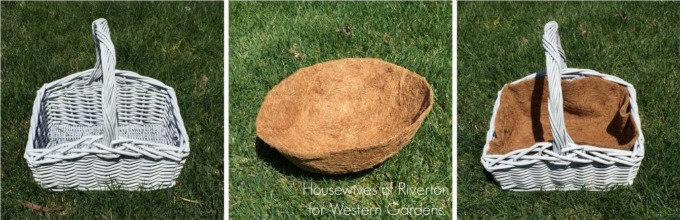
For this project you’ll need:

  • Favorite flowers
  • Basket
  • Potting Soil
  • Basket Liner

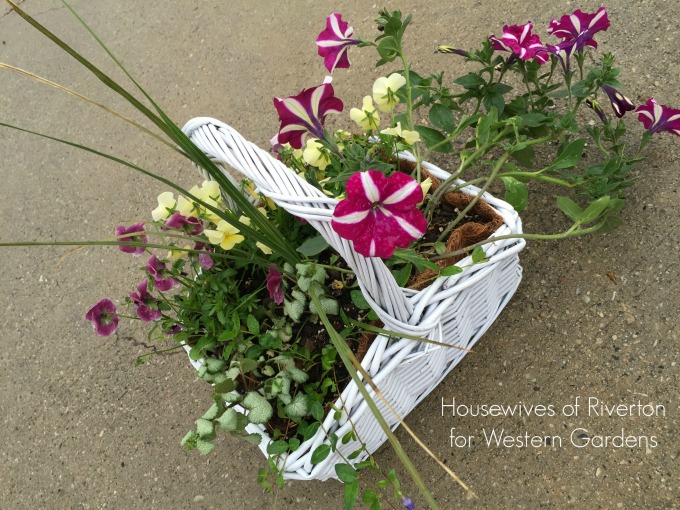
For my particular basket I collected some of my favorite flowers and an old Easter basket.  The Easter basket was blue and that didn’t work for what I wanted, so I started by painting it white.  I was happy that the basket liner fit well inside which helped make everything look nicely put together.

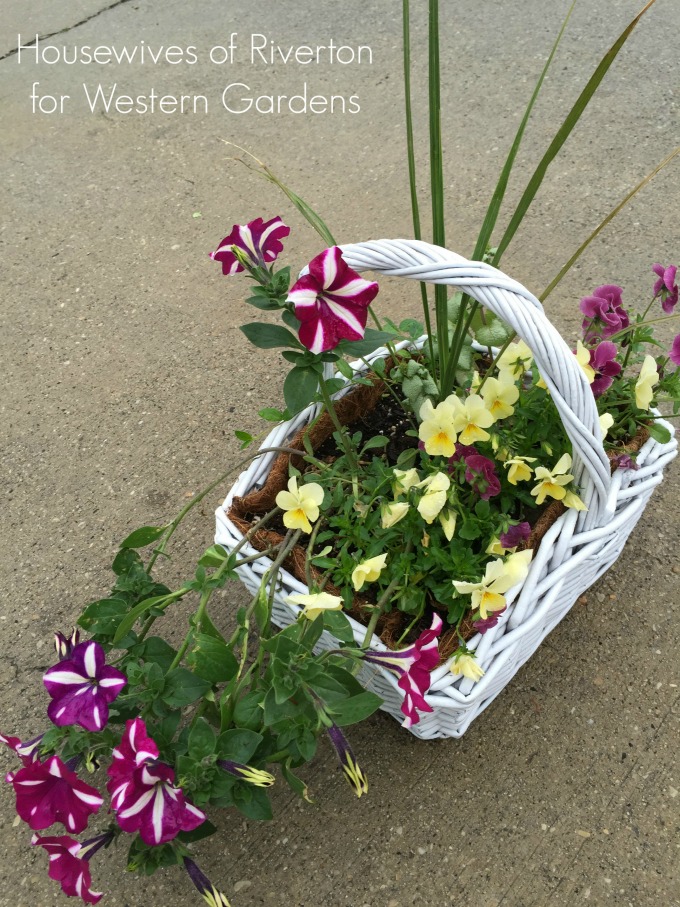
Looking for a simple but beautiful gift for Mom? Try this Mother's Day Flower Garden in a Basket!
The reason I call this a Flower Garden in a Basket is because in a big enough basket you can place the plants inside the basket in their original container making it easy for the receiver of the basket to plant the flowers in their yard or into flower pots if they want to.  For my basket I took the flowers out of their containers but kept them separated with additional potting soil which will still make them easy to remove from the basket if that is what is desired.

Looking for a simple but beautiful gift for Mom? Try this Mother's Day Flower Garden in a Basket!

This basket contains the following flowers/plants:

  1. Cordyline Indivisa Spikes
  2. Pansies
  3. Trailing Petunia
  4. Red Nancy
  5. Bowles Cunningham Periwinkle

If they stay in the basket they’ll fill in beautifully and look fantastic on an outdoor table or on the porch.  If they are taken out of the basket they’ll be a wonderful addition to the yard or another flower pot.

I can’t wait to put a few more of these together to give to some of the best Mother’s I know!

Here are a few breakfast recipes sure to make Mom smile when you make her breakfast in bed Mother’s Day morning!

Looking for a simple but beautiful gift for Mom? Try this Mother's Day Flower Garden in a Basket!
Stuffed French Toast Casserole ~ Breakfast Burritos ~ Strawberry Shortcake Pancakes

Filed Under: Annuals, Container Gardening, Crafts, Flowers, Gardening, How To, Perennials, Tips & How To's Tagged With: flowers, Gardening, How To, how to's, Mother's Day

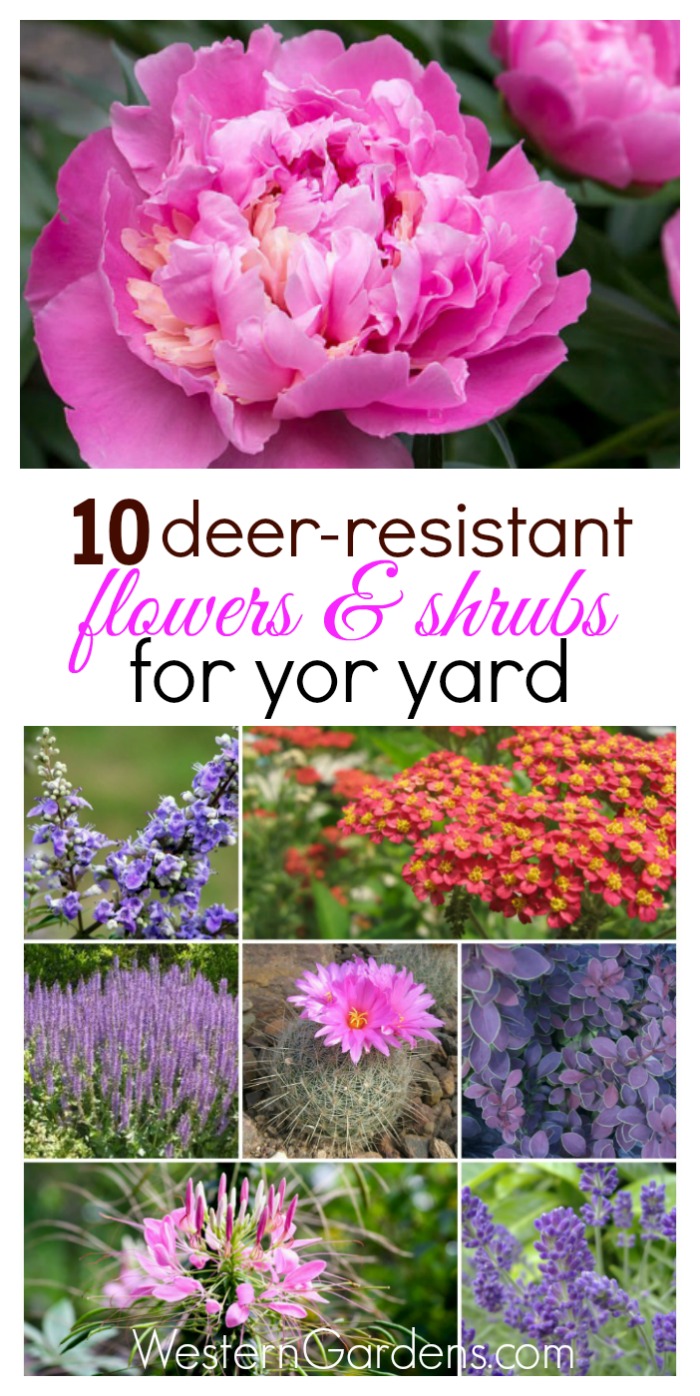
10 Deer-Resistant Plants

April 27, 2016 by Heather Leister

Welcome, I’m so glad you stopped by!

Are deer eating everything you plant? Try these 10 deer-resistant plants, your landscape will thank you!

Do you have frequent visitors to your yard?  Visitors that may not be very welcome…because they’re eating your landscape?!  Oh, deer!  If you get these visitors like we do, we are here to help!  We’re sharing 10 beautiful plants you can add to your flower beds and containers, that deer will leave for you instead of taking for a snack.

Several years ago we moved to a new area with a well-known urban deer population. The city’s deer herd was notorious for visiting yards and sampling the local landscaping. In the beginning, being in the midst of the deer was a treat. We had never lived in an area with this much access to wildlife.

The novelty quickly wore off as our plants began to vanish.

Plants that had thrived for years in our old yard were no match for the deer’s appetites. It became clear that we had to adapt our landscaping or our yard would continue to serve as a 24-hour deer buffet.

Through research, trial and error, we found deer-resistant plants that grow in our area. There are still a few deer delicacies planted in the yard (I just can’t give up my hostas!) but for the most part we’ve been successful in keeping them away.

When looking for a deer-resistant plant, a good rule of thumb is to choose something fragrant, prickly, or poisonous to the deer. The deer won’t always obey this rule, especially if they’re hungry and food is scarce, but this is a good place to start. Here are 10 deer-resistant plants that thrive in a variety of environments.

10 Deer-Resistant Plants

FRAGRANT PLANTS

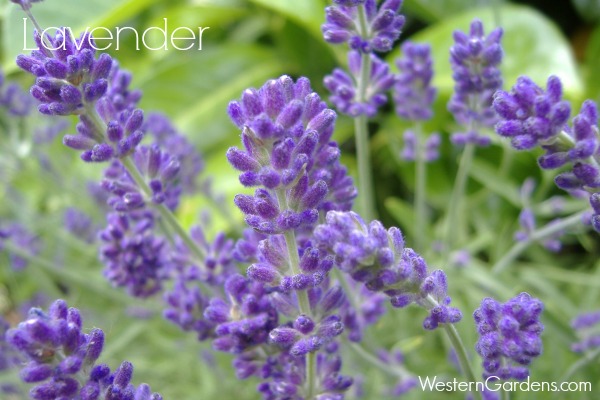
1. Lavender

Are deer eating everything you plant? Try these 10 plants that are deer-resistant, your landscape will thank you!

Lavender is always an excellent choice for a deer resistant plant. This hardy, fragrant perennial requires little water and maintenance.

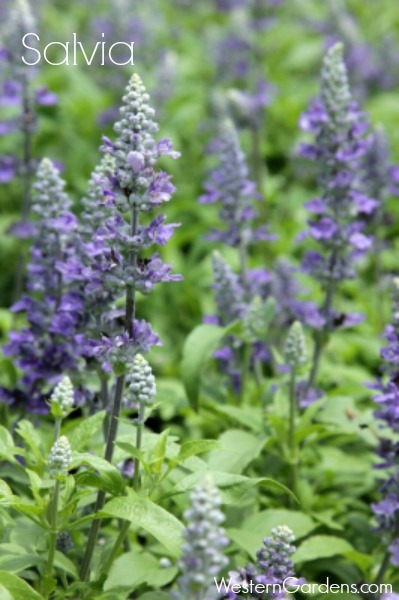
2. Salvia

Are deer eating everything you plant? Try these 10 plants that are deer-resistant, your landscape will thank you!

Salvia is another perennial that produces a strong fragrance which deer find extremely unpleasant. The plant comes in a wide variety of colors and is a strong perennial that will be easy to care for year after year.

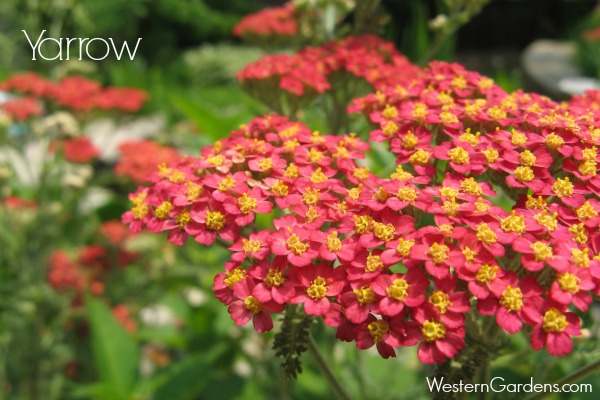
3. Yarrow

Are deer eating everything you plant? Try these 10 plants that are deer-resistant, your landscape will thank you!

Yarrow plants are not overly picky about soil requirements, making them an excellent choice for many people. Bright, colorful flowers bloom throughout the summer, but the deer won’t be tempted to snack thanks to the strong aroma produced by the yarrow leaves.

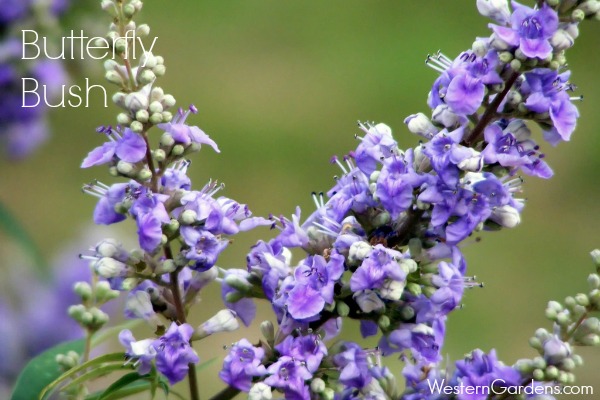
4. Butterfly Bush

Are deer eating everything you plant? Try these 10 plants that are deer-resistant, your landscape will thank you!

 Another fragrant, drought-resistant perennial, Butterfly Bush is an excellent choice if you are looking for a flowery, deer resistant shrub. It grows quickly, produces a large amount of blooms, and does well in almost any type of soil.

Click NEXT to see which beautiful prickly plants will keep deer away! Western Garden Centers | Salt Lake City | Sandy | West Valley UTAH

Salvia image courtesy of Rawich at FreeDigitalPhotos.net
Lavender and Yarrow images courtesy of wikimedia commons
Butterfly Bush image courtesy of staticflickr

Pages: Page 1 Page 2 Page 3

Filed Under: Flowers, Gardening, Outdoors, Perennials, Tips & How To's, Yard Care Tagged With: flowers, Gardening, how to's, tips, Western Garden Centers

Best Plants for Window Boxes

April 23, 2016 by Jenn Crookston

Welcome!  I’m so glad you stopped by!

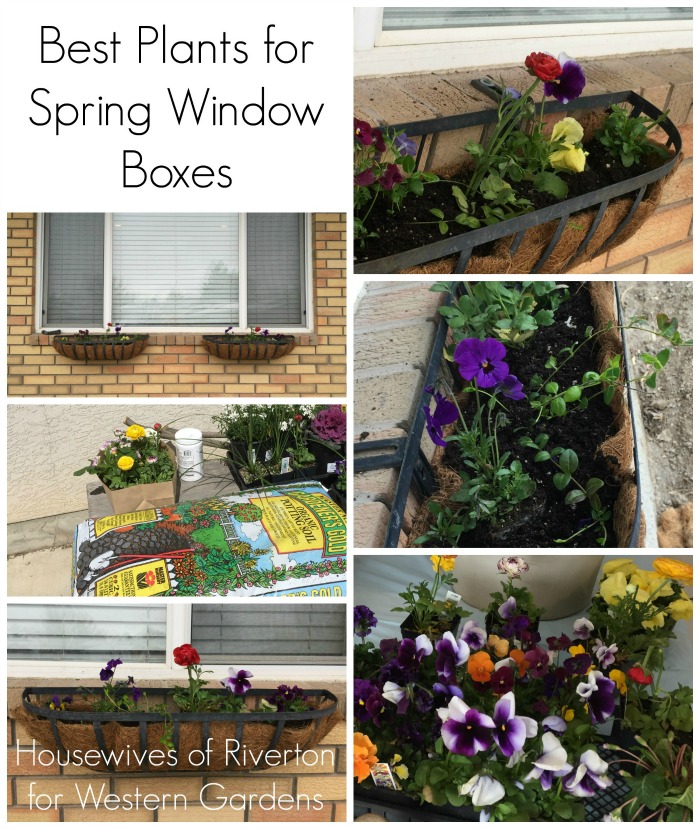
Are you looking for the best plants that will really stand out in your window boxes this year?  Flowers that will thrive, even in uncertain Spring weather?  Then you’ve come to the right place!  I’m sharing 6 of my favorite picks for gorgeous window boxes.

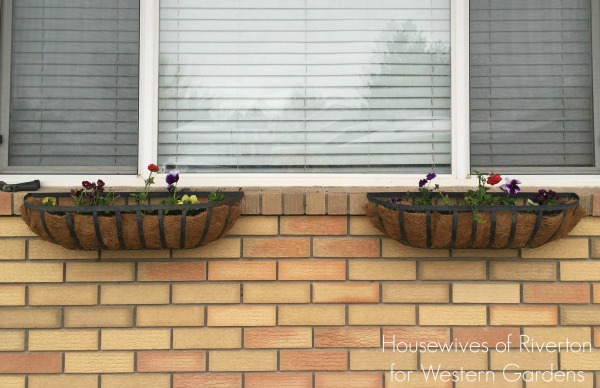
The best plants for your spring window boxes! Flowers that will survive sun and snow.Those who know me well know that my house and I just aren’t best friends.  I probably couldn’t have picked a house with an exterior that I like less!  But since an all-new exterior isn’t in the plans, I have to do what I can to make it as pretty as possible.

The best plants for your spring window boxes! Flowers that will survive sun and snow.

A few years ago I finally convinced my husband that we needed flower boxes for the windows.  We’ve had varying degrees of success, so this year I am determined to get these window flower boxes prize-worthy!  You know what I’m talking about, right? Jaw-dropping window boxes like this one from The Lily Pad Cottage.
The best plants for your spring window boxes! Flowers that will survive sun and snow.
Isn’t it just beautiful? I’m in awe.

I needed some advice to start out right in my quest for gorgeous window boxes, so I headed to Western Gardens to get some help.  Andrea answered all my questions and gave me some great tips that I can’t wait to share with you!

The best plants for your spring window boxes! Flowers that will survive sun and snow.

Prep Your Boxes Correctly:

  • Replace the liners in each flower box.  I was amazed at what this did to make everything look better immediately!
  • Fill the liners a little less than half full with styrofoam packing peanuts.  This will reduce weight and save potting soil, and allow more air and water to get to the roots.
  • Fill the rest of the liner with fresh potting soil, like Gardner’s Gold.
  • Plan out your flowers.  I planted earlier in the spring than normal, so I made sure to choose flowers that were all cold-tolerant (since April snow is a thing here!)
  • Ensure you have doubles of every flower, if you need to make matching boxes like I did.
  • Don’t overfill your boxes. Let your flowers get established before you fill in gaps.

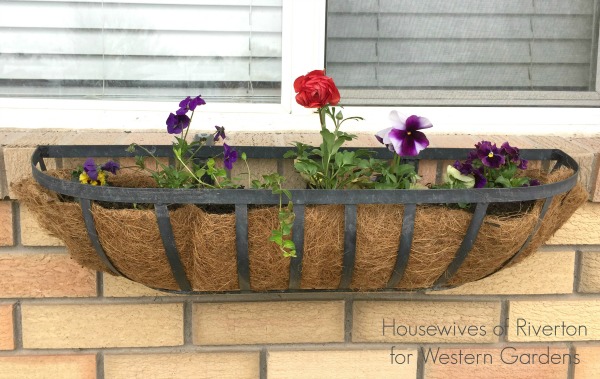
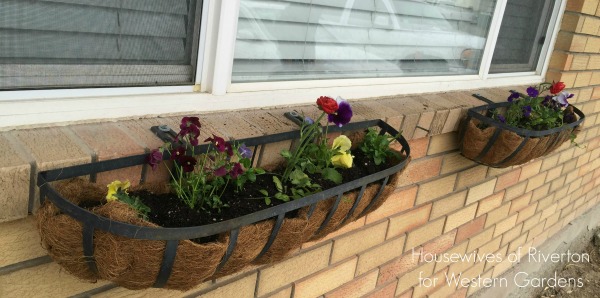
Window Box Flowers (left to right, repeated in each box):

  1. Pansy Frizzle Sizzle Mix
  2. Primrose Danova Mix
  3. Vinca Bowles Cunningham Periwinkle
  4. Ranunculus Bloomingdale Mix
  5. Pansy Delta Premium Beaconsfield
  6. Pansy Matrix Lemon
  7. Pansy Frizzle Sizzle Mix

The same rules apply to window boxes as porch pots.  To create a truly awe-inspiring display, you need a filler, a spiller, and a thriller.  See my tips for porch pots if you’re not sure what this means!

Pansies and primrose are great fillers with a lot of wonderful color.  The Vinca will spill beautifully over the sides, and the tall, red Ranunculus is currently thrilling my boxes!

As these flowers grow and spread, they will fill the boxes nicely. These flowers should all last several months, depending on how quickly our Utah weather turns hot.

The best plants for your spring window boxes! Flowers that will survive sun and snow.

Two final tips for healthy window boxes:

  • Check the water regularly.  The heat from the house may increase your boxes’ water needs.
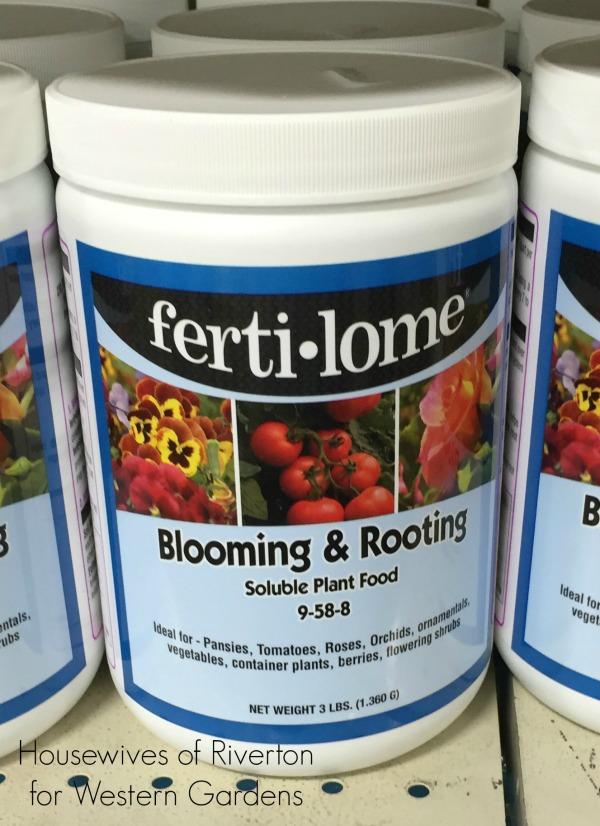
  • Fertilize regularly for the best blooms.  I use ferti-lome blooming and rooting soluble plant food, which is perfect for big, beautiful blooms.  Click here to see why I recommend this one!

I can’t wait to share how my window boxes progress this summer.  Here’s to growing gorgeous!

While I’m waiting for my flower boxes to fill out, I’ll be enjoying these delicious recipes with my family:

The best plants for your spring window boxes! Flowers that will survive sun and snow.
Gluten Free Oatmeal Cookies ~ Spinach Salad w/Poppy Seed Dressing ~ Strawberry Lemonade Cookies

Filed Under: Annuals, Container Gardening, Gardening, Utah Gardening Tagged With: flowers, Gardening, How To, how to's, tips, Utah, Western Garden Centers, Western Gardens

Mother’s Day Flower Pots

April 19, 2016 by Sydney Anderson

Welcome!  I’m so glad you’re here!

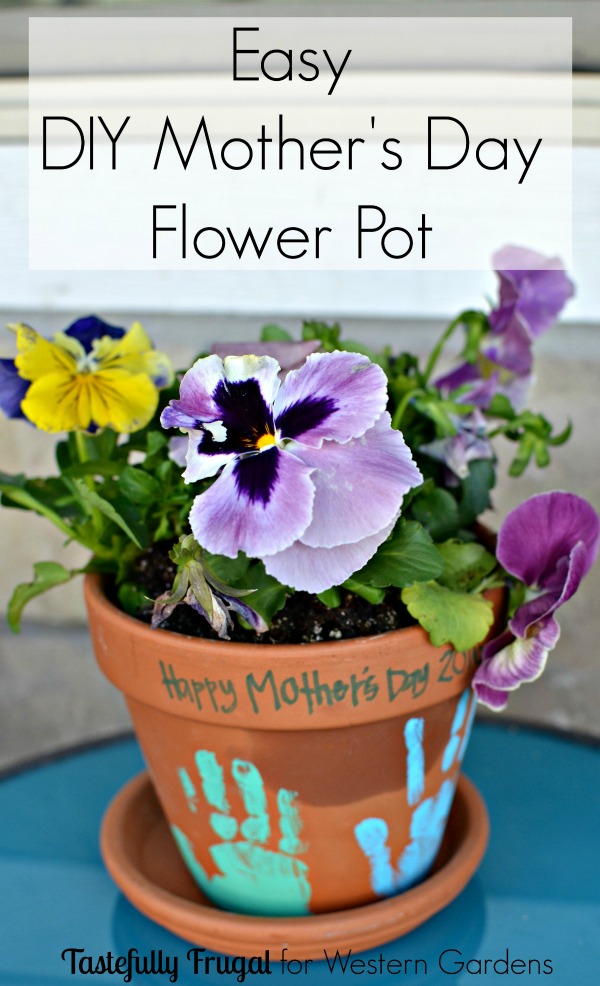
Are you looking for a simple, inexpensive present that the moms in your life will not just cherish, but enjoy every day?  Then create this bright and fun Mother’s Day gift, with the help of little hands!

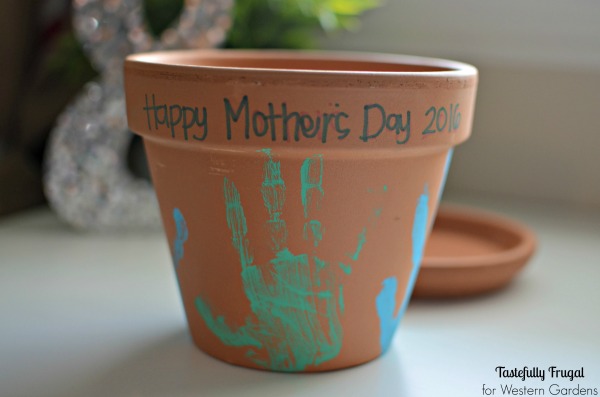
Mother's Day Flower Pots are the perfect gift for all the mothers in your life! A sweet and simple gift to bring a pop of color to her home and a smile to her face.

Mother’s Day is right around the corner. Somehow this holiday always sneaks up on me! Maybe it’s because we have 5 bazillion birthdays from March to May or maybe it’s because with the warmer weather, I want to spend every waking moment outside; but it seems like I always remember Mother’s Day the Friday before and am always scrambling to make something for the moms in my life. But not this year!

Mother's Day Flower Pots are the perfect gift for all the mothers in your life! A sweet and simple gift to bring a pop of color to her home and a smile to her face.

I’ve learned that handmade gifts are the way to go when it comes to moms (and grandmas). Not only do they always bring a smile to their face, but it’s also more fun to make gifts. And it’s a lot more affordable too!

Mother's Day Flower Pots are the perfect gift for all the mothers in your life! A sweet and simple gift to bring a pop of color to her home and a smile to her face.

For this gift, I enlisted help from my two partners in craft. This gift couldn’t be any easier to make, and what kid doesn’t love getting a little dirty?!

Mothers-Day-Pot-Supplies

Mother’s Day Flower Pots

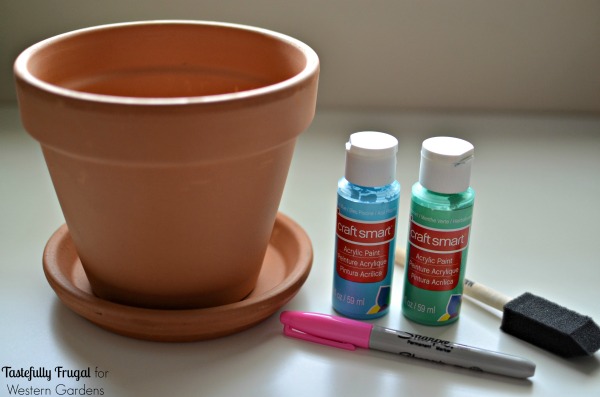
Supplies

  • Terra Cotta Pot – I used a 6″ because it was the perfect size for my boys’ hands. You may want a bigger or smaller one depending on how big your kids’ hands are.
  • Saucer to go under the pot – This terra cotta saucer costs about $1 but you can get a plastic one for much less.
  • Paint – I like using acyrlic craft paint (like these) because it dries quickly and is easy to clean up.
  • Sponge Paint Brush(es) (optional) – I’ve found after doing hand print art with my boys, the hand prints turn out clearer if you brush the paint onto their hands instead of letting them put their hands in the paint by themselves.
  • Sharpie
  • Flowers – you can buy them now or wait until you’re ready to give your gift. Western Gardens always gets a big shipment of new flowers just before Mother’s Day.
  • Potting Soil

Mother's Day Flower Pots are the perfect gift for all the mothers in your life! A sweet and simple gift to bring a pop of color to her home and a smile to her face.

Directions:

  1. Pick mom’s 2-3 favorite colors (or let your kids pick their favorite colors) and pour some on a paper plate.
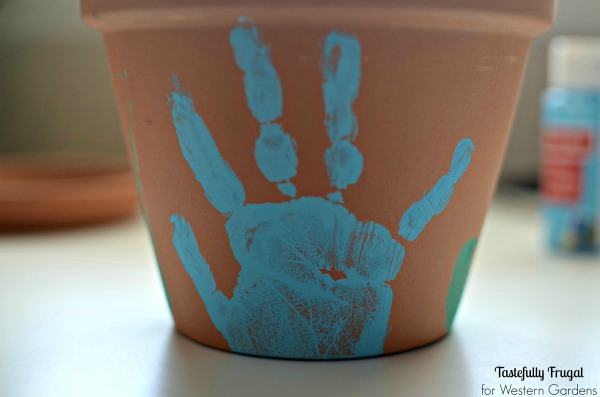
  2. Using your paintbrush, paint the first color on one of your kids’ hands (You can also let the kids press their hands in the paint if you don’t have a paintbrush).
  3. Press hand firmly along side of pot.
  4. Paint the next color on the other hand (or next child’s hand) and space about 1″ from the first hand print on the pot.
  5. Continue with same color pattern spacing about 1″ from the last hand print until you’ve covered the whole pot.
  6. Using your Sharpie, write Happy Mother’s Day 2016 on the rim of the pot. (I thought about attaching a tag that said Happy Mother’s Day 2016, but I know the tag will probably get lost, and in 15 years I probably won’t remember what year we made this!)
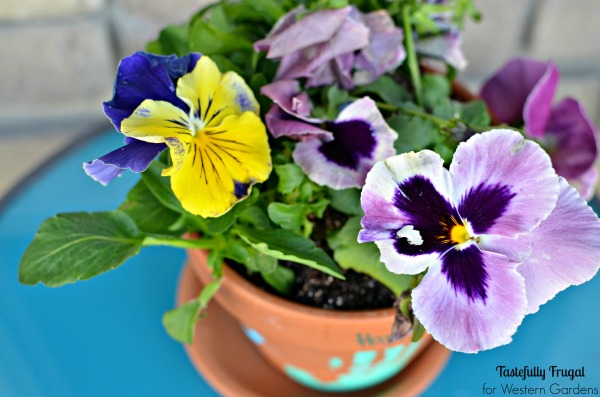
  7. Plant flowers and give to mom.

Mother's Day Flower Pots are the perfect gift for all the mothers in your life! A sweet and simple gift to bring a pop of color to her home and a smile to her face.

What is your mom’s favorite flower? How great would they look in one of these pots?! Check out Western Gardens for a huge selection of flowers any mom would love.

Here are a few more Mother’s Day gift ideas:

Mothers-Day-Printable-Content-It-Is-A-KeeperMother’s Day Free Printable

Thank You For Helping Me Bloom Mother's Day Gift: A fun, quick and easy gift idea for that special mom in your life. #BestMomsDayEver #ad #CollectiveBiasDIY Tissue Paper Flower

Filed Under: Container Gardening, Crafts, Flowers, How To Tagged With: craft, how to's, Mother's Day

8 Tips-Planting Early Spring Flower Pots

April 16, 2016 by Jenn Crookston

Welcome gardening friends!  

Do you love seeing splashes of color in the early spring?  Especially when winter hasn’t quite worn off yet, and the landscape can look a little gray and uninviting?  

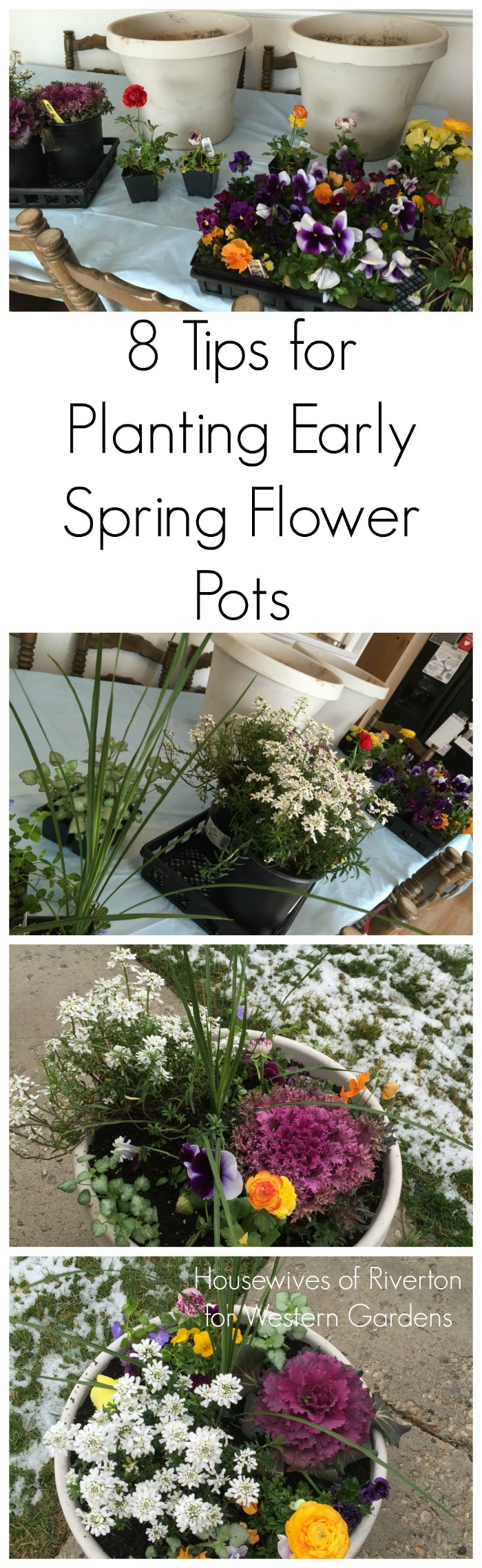
I’m here to help!  With these 8 Tips for Planting Early Spring Flower Pots, you can take your yard from winter-blah to spring-wow!

I am very excited to start gardening this year!  So excited, in fact, that I have no desire to wait for Mother’s Day to get planting (here in Utah, Mother’s Day is about the time to start).

8 Tips for planting early spring flower pots, to help pull your yard out of the winter blues and into the happy colors of spring!

I’ll be honest.  I don’t have a perfect track record with flowers, potted or in the ground. My plants don’t always die, but my record is inconsistent and it doesn’t seem to matter if I do the same thing each year or not, it’s still hit or miss.

But I didn’t want swing and miss this year, so I headed to Western Gardens with my mother-in-law Sue (my personal go-to flower guru) and we consulted the experts there.

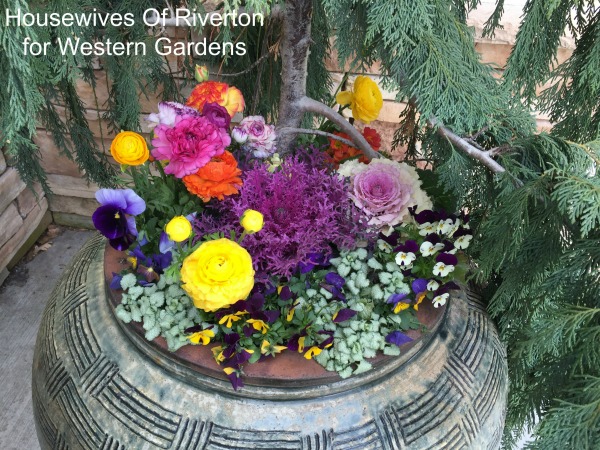
When we first arrived at Western Gardens I couldn’t help but notice all the beautiful flowers they already had in their pots out front.

8 Tips for planting early spring flower pots, to help pull your yard out of the winter blues and into the happy colors of spring!

Sue and I both loved this pot!  Since it’s still quite cold, I was impressed with how much color was in the pot and how great the flowers looked. Some even had ice sitting on them, and yet here they were in their vibrant beauty!

To make sure we were doing everything possible to have the best chance of success, we asked a Plant Pro from Western Gardens to help us out.  Andrea answered all of our questions and gave us so much great advice! I appreciated her friendly personality and really appreciated that she never once made me feel foolish for my lack of knowledge.

I was thrilled to discover such a wide variety of flowers and plants that are cold-weather hardy and perfect for early spring flower pots. With our temperamental Utah springs, we can have beautiful spring-like weather in February, only to have snow on the ground in April.  With these cold-weather flowers, I can have blooms all spring long.

8 Tips for planting early spring flower pots, to help pull your yard out of the winter blues and into the happy colors of spring!

8 Tips for Planting Early Spring Flower Pots:

1. Talk to your local gardening shop (if you’re here in Utah, visit Western Gardens in Sandy, Downtown Salt Lake, and West Valley City).  Ask them what flowers and plants work best in your area for early spring planting.  It will vary depending on your location and climate.  To make the most of your pots, you’re going to want expert advice!

2. Choose a filler, a spiller, and a thriller (these are different flowers that will fill in the pot, spill down the sides, and thrill the eye…think grass spikes)!  Click HERE for more details.

3. Gather other necessary supplies:

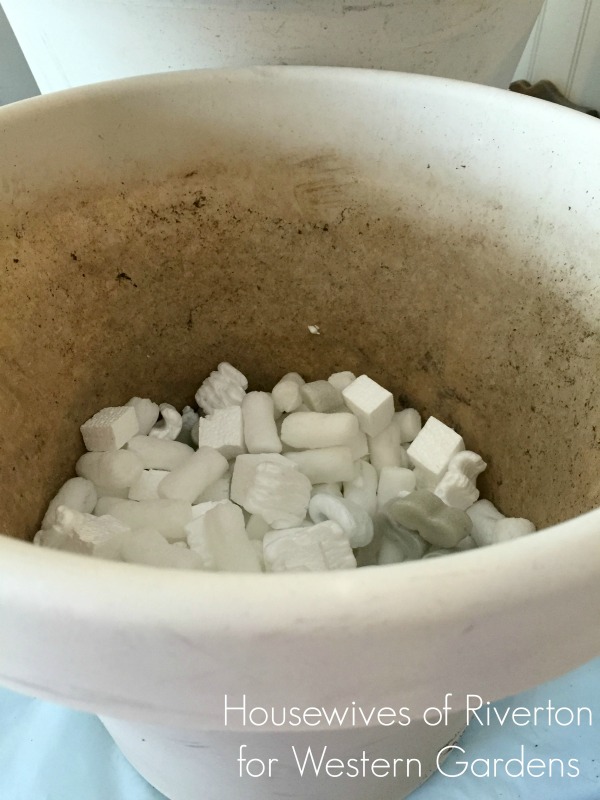
  • Styrofoam packing peanuts (enough to fill each pot 1/3 full)
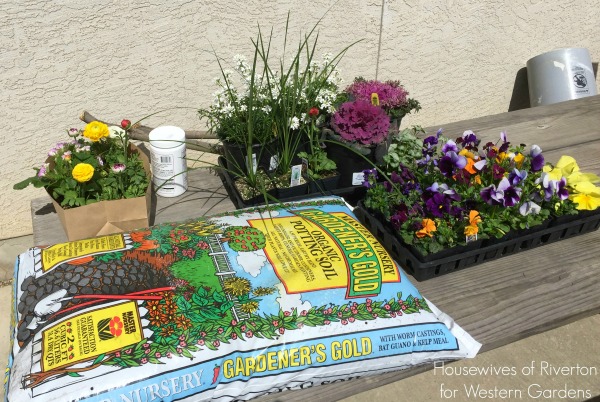
  • Fresh potting soil (like Gardener’s Gold)
  • Fertilizer (like ferti-lome blooming and rooting soluble plant food. The high middle number (9-58-8) is responsible for the flowering of plants and flowers, which means it’ll help your potted plants/flowers have beautiful blooms − or if you’re planting fruits/veggies, this helps with food production.)

8 Tips for planting early spring flower pots, to help pull your yard out of the winter blues and into the happy colors of spring!

4. Fill your pot 1/3 full with styrofoam packing peanuts (they partially fill the pot without adding weight, and allow for air and water to have room to move around the roots of the plants). Fill the remaining 2/3 of your pot most of the way with potting soil (leaving a few inches of space at the top, you’ll need it in a few minutes!).

8 Tips for planting early spring flower pots, to help pull your yard out of the winter blues and into the happy colors of spring!

5. Arrange your flowers in the pot before you plant. Here I’ve got my plants all laid out to get an idea of how I want the pot to look when it’s finished. Once you’re happy with the arrangement, then start potting each one (don’t forget to gently tear some of the roots on each flower before you plant it, this helps the roots spread into the surrounding soil and promote growth).

8 Tips for planting early spring flower pots, to help pull your yard out of the winter blues and into the happy colors of spring!
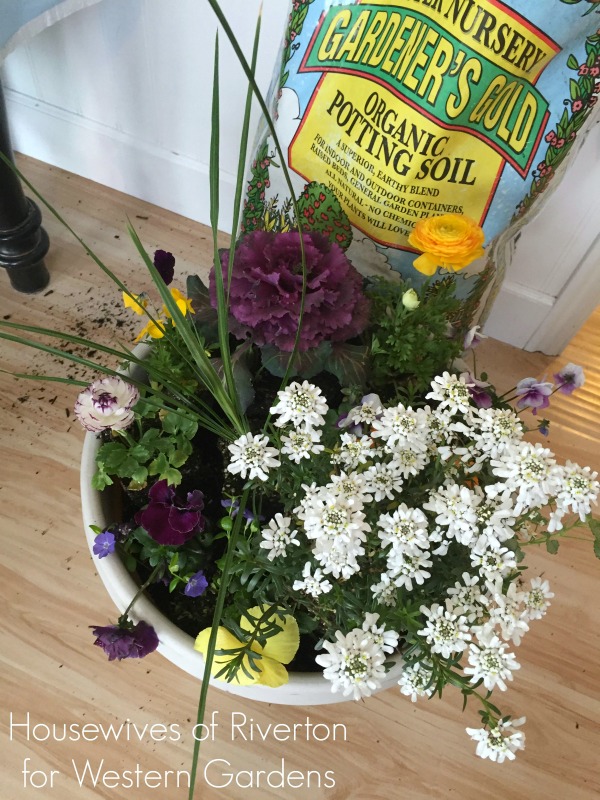
6. Add more potting soil once all your plants are potted, to fill in any holes.

7. Water your flowers to make sure they’ve got a nice, fresh drink to help keep them perky.  Don’t oversaturate your pot.

8. Fertilize, dead-head & water your flower pots to keep them looking their best all spring!  Fertilize regularly (organic and chemical fertilizers have different instructions, read carefully!  We recommend organic for pots, as chemical fertilizers leave a salt residue), remove expired blooms (so the plant’s energy can go to make new ones!), and water when soil is just barely moist (don’t let it dry out).

8 Tips for planting early spring flower pots, to help pull your yard out of the winter blues and into the happy colors of spring!

The plants and flowers featured in my pots are:

Fillers:

  • Pigeon Purple Flowering Kale (perennial) 
  • Flowering Cabbage (perennial) 
  • Candy Tuft Tahoe (perennial)
  • Pansy Fizzle Sizzle Mix (annual)
  • Pansy Matrix Lemon (annual) 
  • Ranunculus Bloomingdale Mix (annual) 
  • Pansy Delta Premium Beaconsfield (annual)
  • Primrose Danova Mix (annual) 

Spillers

  • Red Nancy (annual) 
  • Bowles Cunningham Periwinkle (annual) 

Thrillers

  • Cordyline Indivisa Spikes (annual) 

8 Tips for planting early spring flower pots, to help pull your yard out of the winter blues and into the happy colors of spring!

I am absolutely in love with how my pots turned out!  And with these tips and advice, I know I’ll have beautiful pots all spring. A few of the plants I chose are perennials (they’ll come back year after year), so when they stop blooming, they can be replanted in the ground for next year! 

These flowers will all last several months, and possibly through June, depending on how quickly it gets hot. I love that my pots are already planted, and that I can add other flowers as some of them expire, to keep some beauty outside my home all spring, summer and fall!

8 Tips for planting early spring flower pots, to help pull your yard out of the winter blues and into the happy colors of spring!

Now that all my flowers and plants look so beautiful, I need some new pots for them!  I think that will be my reward for keeping them pretty and healthy all season.

Here are a few more things to love about Spring that you can find over on my blog!

RHW Collage
Gluten Free Oatmeal Cookies ~ Spinach Salad w/Poppy Seed Dressing ~ Strawberry Lemonade Cookies

Filed Under: Annuals, Container Gardening, Flowers, Gardening, How To, Perennials, Tips & How To's Tagged With: flowers, Gardening, how to's, spring

Compost and Amending Soil

February 23, 2016 by Becky

Compost | Amending Soil | Why you should STOP tilling your garden!  www.westerngardens.comCompost | Amending Soil | Why you should STOP tilling your garden!

Compost and amending soil can seem tricky and intimidating if you’re not sure where to start.  It’s actually a simple process that will give you great results in your garden and better nutrition in your harvest.  We’re breaking it down for you and explaining why we recommend {or don’t recommend!} different products and processes.  Let’s get started!

compost and soil ammendments | gardening | how toAmending Soil–What is it, Why and How Often?

Amending soil means adding organic matter to your garden in order to give back the nutrition your fruits & veggies took from it last year to grow your healthy, beautiful plants.  Without soil amendments, your garden could be deficient in different nutrients necessary to grow healthy plants and yield a strong harvest.  You should amend your soil every year by placing a 2-3″ layer of compost over your garden beds.

Why Compost?

Also called Gardener’s Gold or  Black Gold, compost is both partially decomposed organic matter {mostly plants and the manure of plant-eating animals} and the microbes that do the decomposing.  Because it is made up primarily of plant matter, compost contains the right proportion of the elements needed for plant growth.  Compost does many things for your soil, including:

  • Provides Nutrition  It’s the source of all basic nutrition for plants.
  • Improves Soil Structure  It separates soil particles and creates aeration, and nurtures the organisms that build and maintain it.
  • Increases the Ability of Soil to Retain Water Compost can hold up to 6 times its weight in water.
  • Contributes to the Health of Plants  May help prevent some diseases and promotes plant growth.
  • Moderates Soil pH  Most compost is already the ideal pH for optimal plant growth, and will help moderate the pH level in the soil.
  • Feeds Soil Organisms  Compost is the food source for many, many organisms whose activities greatly improve soil structure, increase aeration and water retention, and make it easier for plant roots to grow.  Compost feeds not only worms, but also soil bacteria and fungi, protozoa, nematodes, and more.  (The Vegetable Gardener’s  Bible, 142)

compost and soil ammendments | gardening | how to

Bumper Crop

Bumper Crop Organic Soil AmendmentNot everyone can compost because of space, time, location, or other reasons.  You can still amend your soil even if you don’t save your kitchen scraps and lawn clippings!  Our favorite soil amendment is Bumper Crop, a compost with an organic fertilizer, mycorrhizae (a beneficial bacteria that supports stronger root systems), worm castings (lots of plant-ready nutrients), and kelp meal (filled with micro-nutrients).  This is what we use in our own gardens, and recommend to our customers.

Click NEXT to find out why you might NOT want to till your garden!

Next Button


Images courtesy of winnod and posterize at FreeDigitalPhotos.net

Pages: Page 1 Page 2

Filed Under: Gardening, Tips & How To's, Yard Care Tagged With: compost, dirt, flowers, gardening, how to's, soil, tilling, veggies, Western Gardens

  • Go to page 1
  • Go to page 2
  • Go to Next Page »

Primary Sidebar

Shopping Cart

Items in Your Cart

Your cart is empty
Visit The Shop

Follow Western Gardens

  • Facebook
  • Instagram
  • Pinterest
  • YouTube

See what we’ve been pinning!

Follow Me on Pinterest
Followed by people.
?

Pinterest Badge by Skipser

Here’s What We’ve Been Up To!

Save water and money by Turf Training - train your lawn to grow deep roots
work at western gardens utah garden center
Senior gardening woman Edu Carvalho from Pexels
A Utah Guide to Vertical Gardening in square shape

Copyright © 2026. Western Gardens - Privacy Policy